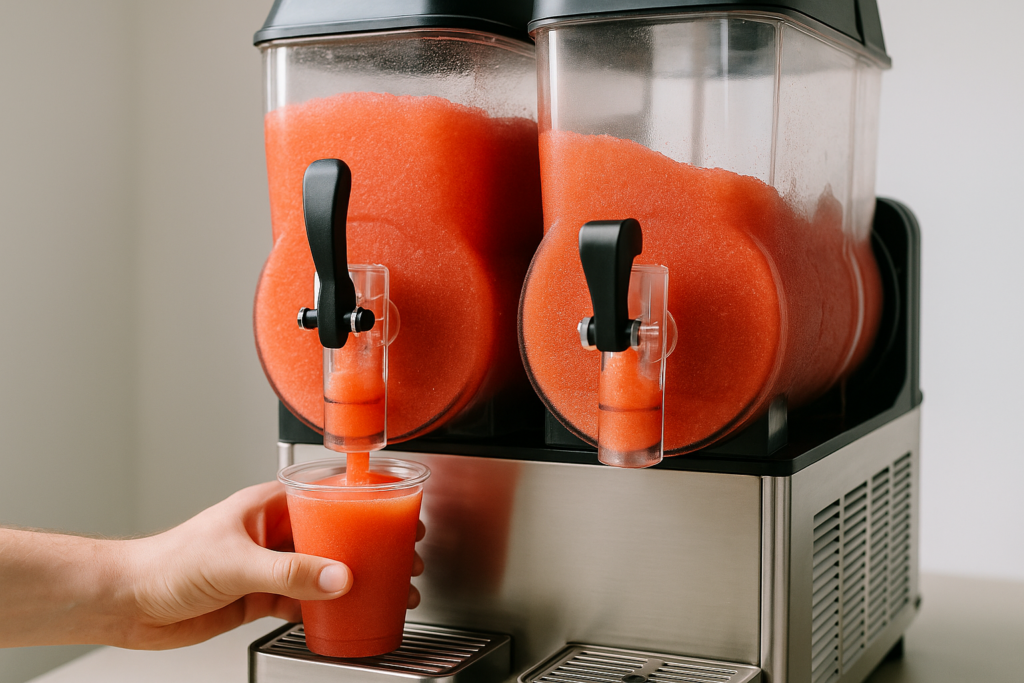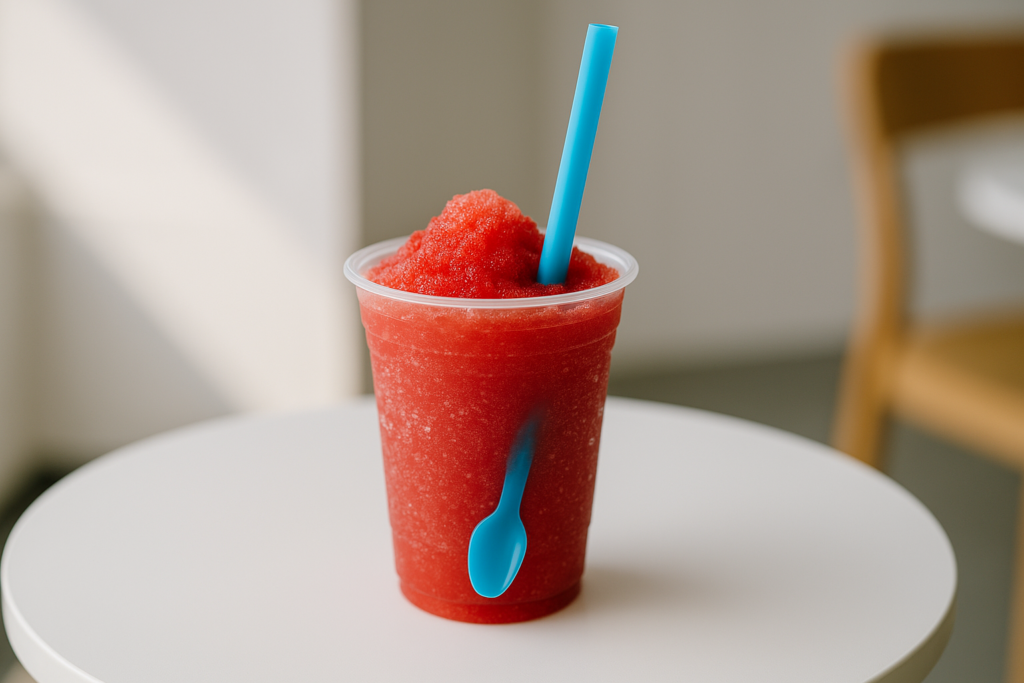
Short answer: yes, straw size actually matters for a slushy, and it matters more than it does for any other drink you own. Because slush is a semi-frozen slurry rather than a liquid, the width of the tube decides whether you get a smooth pull or a red-faced struggle with a cup that refuses to cooperate. The fluid physics behind it is surprisingly unforgiving, and a couple of millimeters is the difference between a great drink and a jaw workout.
Below is what straw diameter really changes, what the common sizes are, and how to pick the right one for the drink in front of you.
The Short Version
For a standard slushy with fine ice crystals, an 8mm to 10mm inner diameter straw hits the sweet spot: wide enough to move slush without heroic suction, narrow enough that you do not dump a mouthful of ice onto your palate at once. A 6mm soda straw works for thin, syrupy slush but clogs on anything with real ice content. Anything above 12mm (boba territory) moves slush beautifully and gives you brain freeze in about ten seconds flat.
The Physics: Why Two Millimeters Changes Everything
Flow through a narrow tube does not scale with width in a friendly, linear way. Under Poiseuille’s law, the flow rate through a cylindrical tube is proportional to the fourth power of the radius. That single fact explains almost every straw argument you have ever had.
Run the math and it gets silly fast. A straw with twice the diameter of another, at the same suction pressure, moves roughly sixteen times as much volume per second. Going from a 6mm straw to an 8mm straw, a difference you can barely see, gives you about a 3x increase in flow.
That is not a preference thing. That is arithmetic.
The other half of the equation is how much suction a human can actually produce. Most people can pull somewhere in the range of 1 to 2 psi comfortably, which is enough to lift water about a meter up a tube. You have a fixed, fairly weak pump. The straw is the only variable you control.
Slush Is Not a Liquid, and That Breaks the Normal Rules
Poiseuille’s law assumes a Newtonian fluid, which slush absolutely is not. A slushy is a suspension of ice crystals in sugar syrup, typically 30% to 50% ice by volume, held somewhere between 21°F and 28°F. It behaves more like a soft solid with a yield stress: below a certain force it does not flow at all, and above it, it suddenly does.
Two things follow from that:
- Particle size sets the floor. If your ice crystals are 2mm across and your straw bore is 4mm, you are going to bridge and jam. Crystals lock against each other at the entrance and form an arch, exactly like grain stuck in a hopper.
- Wall friction scales badly. Slush drags against the tube wall much harder than soda does, so narrow straws lose a disproportionate amount of your suction to friction before anything reaches your mouth.
- Melting helps, but slowly. The reason a stuck straw eventually clears is that body heat and room temperature soften the plug. That takes 20 to 60 seconds, which is 20 to 60 seconds of not drinking.
This is also why a machine-churned slushy behaves differently from a blender slushy. Blenders produce chunkier, less uniform crystals, which is one reason homemade slushies made without a machine often need a wider straw than the ones from a gas station.
Related reading: One Hole or Two? The Great Straw Debate.
Related reading: The Proper Way to Drink a Slushy.
For a closer look at this topic, see our guide: Things Every Friend Group Does During Summer.
Related reading: How to Unclog a Slushy Straw Without Losing Your Mind.
Actual Straw Sizes, Measured
Straw sizing is loosely standardized and usually quoted as outer diameter, so the usable bore is often 0.5mm to 1mm narrower than the number on the box. Rough guide:
- Cocktail / stirrer straws: 3mm to 4mm. Useless for slush. These exist to stir things.
- Standard soda straw: 6mm. Fine for melted slush and thin frozen lemonade, unreliable for anything thick.
- Jumbo / milkshake straw: 8mm. The workhorse. Handles most commercial slush without drama.
- Spoon straw: usually 8mm to 10mm, often with a flattened scoop end.
- Boba / smoothie straw: 10mm to 12mm. Moves slush effortlessly, delivers a large cold bolus straight to the roof of your mouth.
- Novelty crazy straws: typically 6mm to 8mm, but every bend adds resistance, so effective flow is worse than the diameter suggests.
That last point is worth sitting with. We got into it properly in our piece on whether slushy straws are better straight or crooked, and the short version is that geometry costs you almost as much as width gains you.
The Brain Freeze Tradeoff
Here is the part nobody accounts for when they buy the widest straw available. Brain freeze, formally sphenopalatine ganglioneuralgia, is triggered when something very cold hits the roof of your mouth and the blood vessels there rapidly constrict and then dilate. According to the Cleveland Clinic, the pain usually starts within about 10 seconds of the cold stimulus and clears in under five minutes.
Volume delivered per second is the trigger, and straw width controls volume delivered per second. A 12mm straw can put three or four times the cold mass on your palate as an 8mm straw in the same half-second sip. So the wide straw that feels like an upgrade in the parking lot becomes a liability by sip four.
If you want the mechanics in more detail, we broke it down in why slushies give you brain freeze. The practical takeaway: aim slush toward the side of your tongue rather than straight up at the palate, and let a wide straw sit for a second between pulls.
Why the Spoon End Exists
The scoop on the end of a classic slushy straw is not decoration and it is not a marketing gimmick. It solves the endgame problem, which is that the last third of any slushy is too thick and too settled to travel up a tube at all. Rather than making the straw wider (and worse for sipping), the spoon lets you switch modes.
It is a genuinely elegant bit of design: one tool, two flow regimes. The straw handles the drinkable phase, the spoon handles the compacted phase, and you never have to tip the cup at that undignified 80 degree angle. There is more on the origin story in our post on why slushy straws have a spoon on the end.
Material Changes the Answer Too
Diameter is the main variable, but what the straw is made of affects both the bore and how long it survives.
- Paper: thick walls eat into the inner diameter, and the surface softens after 10 to 20 minutes in a cold, wet drink. A paper straw needs to be a size wider than plastic to feel equivalent.
- PLA and other bioplastics: hold shape better than paper but can go brittle at slushy temperatures.
- Stainless steel: smooth bore, excellent flow, and an outstanding thermal conductor, which means it will happily deliver cold straight to your teeth.
- Silicone: forgiving on teeth, slightly grippier wall, fine at 10mm and up.
- Reusable hard plastic: the best all-around slush option, since you can buy a known bore size and keep it.
Picking a Size Without Overthinking It
- Judge the ice first. If you can see distinct crystals, go 10mm. If it pours like a thick milkshake, 8mm is plenty.
- Match the cup. A 32 ounce cup with a 6mm straw is a long afternoon.
- Check the wall thickness, not just the advertised diameter, especially with paper.
- Go narrower if you are brain freeze prone. Trading a little flow for pain avoidance is a good deal.
- Keep one reusable straw in the car or the bag so you are not at the mercy of whatever the drive-thru hands you.
If you are building slushies at home and want to control crystal size directly, the home slushy guide covers sugar ratios and freeze timing, which honestly matters more than the straw does.
Frequently Asked Questions
What is the best straw diameter for a slushy?
Between 8mm and 10mm inner diameter works for the large majority of slushies. That range moves thick slush without excessive suction while keeping each sip small enough that you avoid instant brain freeze.
Why does my straw keep clogging with slush?
Clogs happen when ice crystals are larger than roughly half the straw’s inner diameter and bridge across the opening. Stir the drink for 5 to 10 seconds to break up the compacted layer, or move to a straw 2mm wider.
Does a wider straw cause worse brain freeze?
Yes, because pain onset depends on how much cold mass hits your palate per second, and a 12mm straw can deliver three to four times the volume of an 8mm straw per sip. Sipping to the side of your tongue reduces the effect noticeably.
Are metal straws good for slushies?
Metal straws have the smoothest bore and best flow of any material, but stainless steel conducts cold at roughly 16 watts per meter-kelvin, so it gets uncomfortably cold against teeth. They work well for slush if you are not sensitive.
Do crazy straws work with slushies?
Rarely, and only with thin slush. Each bend adds turbulence and resistance, so a 7mm crazy straw performs more like a 5mm straight one, which is below the practical threshold for real slush.
Is a slushy the same thing as a Slurpee?
They are the same category of drink, with Slurpee being 7-Eleven’s trademarked version. We covered the distinction in detail in slushy vs Slurpee and in what a slushy actually is.
Come Get Slushed With Us
We spend an unreasonable amount of time arguing about straw bores, ice ratios and which flavor combination counts as a crime, and you are welcome to join in. Grab something from the Slushy Bros apparel lineup, see what the whole Slushy Bros thing is about, or take a look at our running commentary on AI slop while your drink softens up.