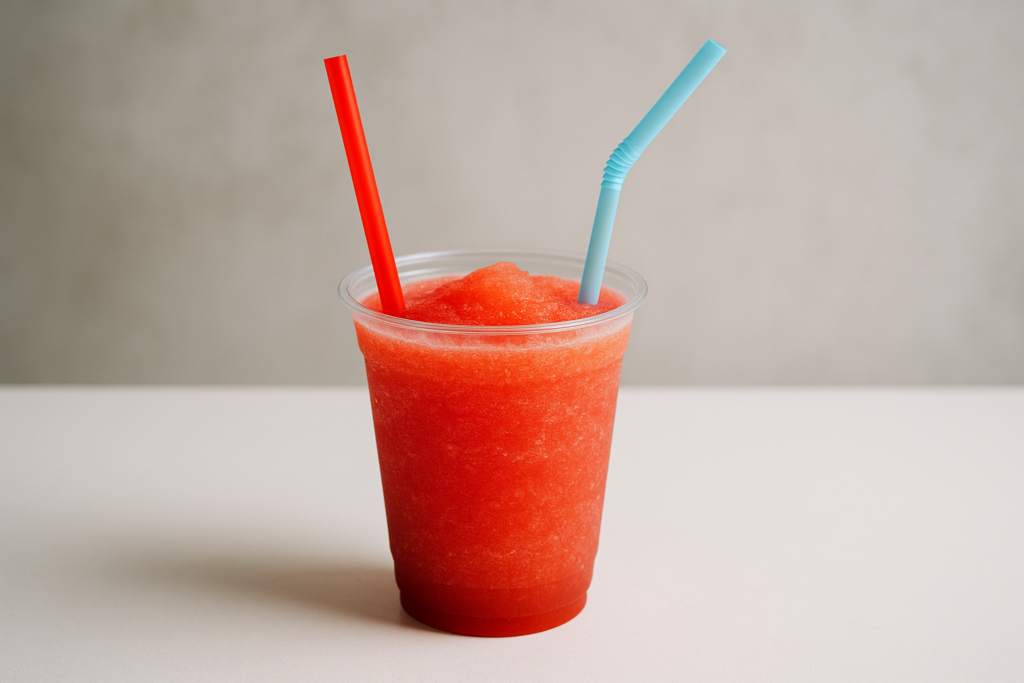
Ask a room of ten people whether a straw has one hole or two and you will get four answers, one argument and at least one person who leaves. The great straw debate has been running in dorm rooms, group chats and Reddit threads for years, and the honest answer is that mathematicians settled it a long time ago while everyone else kept arguing. A straw has one hole, and the reason why is more interesting than the fight.
We sell slushies and spend an unreasonable amount of time thinking about the tubes you drink them through, so consider this the definitive field report. We will cover the math, the logic, the counterarguments and the part nobody talks about: what happens to the count when your straw has a spoon on the end.
The Short Answer: A Straw Has One Hole
Under the branch of math that actually studies holes, called topology, a drinking straw has exactly one hole. The two openings at either end are not separate holes, they are the two ends of the same hole passing through the object. Think of a tunnel through a mountain: nobody says the mountain has two tunnels because you can enter from either side.
Topologists count holes by asking how many ways you can loop a string around an object so the loop cannot be shrunk to a point without leaving the surface. On a straw, there is exactly one such loop, which goes around the tube. That gives the straw one hole, the same count a doughnut gets.
What Even Counts as a Hole?
Most of the confusion in the straw debate is not about straws, it is about the word “hole.” In everyday English we use it for at least three different things, and they do not agree with each other.
- A tunnel that goes all the way through, like the hole in a doughnut, a washer or a straw.
- A cavity or depression that has a bottom, like a pothole, a golf hole or a hole you dig in the yard.
- An opening in a surface, like a hole in your sock or a hole punched in paper.
If “hole” means a tunnel, a straw has one. If “hole” means an opening you can point at, a straw clearly has two, and the people saying two are not being unreasonable, they are just using definition three. The math does not care which word you prefer, but it does insist on being consistent, and consistency is what kills the two-hole answer.
Why the “Two Holes” Argument Feels So Right
Here is the strongest version of the two-hole case: you can see two circles. You can put a finger in the top and a finger in the bottom. Two openings, two holes, case closed, pass the slushy.
The problem shows up the moment you apply that rule elsewhere. Under the two-openings logic, a T-shirt has four holes, a pair of pants has three and a garden hose has two. Now take that garden hose and stretch it until it is as short as a washer.
Nothing has been added or removed, yet suddenly the “two holes” have become one obvious hole. A definition that changes the count when you squash something is not a definition, it is a vibe.
Topology avoids that trap by only counting features that survive stretching and squeezing. A straw, a washer, a doughnut, a wedding ring and a coffee mug are all the same shape to a topologist, each with a single hole. You can read more about the mathematical object behind that idea, the torus, if you want to bring receipts to your next argument.
Is a Straw a Torus or a Cylinder?
Technically, a straw is an open-ended cylinder, also called an annulus once you flatten it. A doughnut is a solid torus. Those are different objects, which is why some people online insist the comparison is cheating.
They are different, but they share the property we care about: both have one independent loop, so both have one hole. Take a real straw, made of plastic with actual thickness, and inflate it slightly in your imagination. You get a stubby doughnut. That is the whole trick, and it works because the plastic wall has volume rather than being an infinitely thin surface.
Can a Straw Ever Have Zero Holes?
Yes, if you break it. Slice a straw lengthwise from top to bottom and it becomes a flat sheet with no holes at all, because now there is no loop you cannot shrink. Crimp one end shut and you have turned it into a cup, which also has zero holes under the tunnel definition, since a cup is just a dent.
That last point trips people up. A cup has an opening you can see and pour into, but no hole in the topological sense, and this is exactly why “how many openings” and “how many holes” are not the same question. Once you accept that a cup has zero holes, the straw answer stops feeling weird.
How Many Holes Do Everyday Objects Have?
The fastest way to convert someone is to run through a list. Using the topological count, here is where common objects land.
- Straw: one hole.
- T-shirt: three holes (the neck and two sleeves form a connected system, which reduces the count from the four openings you can see).
- Pair of pants: two holes.
- Coffee mug: one hole, in the handle.
- Slushy cup with a lid slot: one hole, once the lid is on and the straw slot is cut.
- Sock, before your heel goes through it: zero holes.
If the shirt answer of three surprises you, that is normal. Most people guess four, then spend a minute tracing the fabric with a finger before conceding.
The Part Nobody Argues About: The Straw You Actually Use
Here is our gap in the great straw debate. Almost every version of this argument assumes a plain cylindrical tube, and almost nobody drinking a slushy is using one. The spoon-straw changes the geometry, and it changes the conversation.
A classic spoon-straw has a flattened scoop at one end with a slot or notch cut into the side wall. Each extra cut adds another independent loop, so a single spoon-straw with one side slot has two holes, not one. Add a second slot and you are at three. So the two-holes crowd finally gets a win, just not with the straw they were picturing, and we explain the engineering reason for that scoop in our piece on why a slushy straw has a spoon on the end.
Bore width matters too, though for reasons that have nothing to do with topology and everything to do with how hard you have to suck on half-frozen ice. If that is the rabbit hole you would rather be in, we broke down whether straw size actually matters for a slushy, along with the straight versus crooked question that starts almost as many fights as this one.
How to Win This Argument at a Party
Do not lead with topology. Lead with the garden hose, because the squash test does the persuading for you.
- Ask how many holes a garden hose has. They will say two.
- Ask how many holes a metal washer has. They will say one.
- Point out that a washer is a very short hose, and nothing was removed.
- Let the silence do the rest, then hand them a slushy before they rally.
You will still lose to at least one person who refuses on principle. That is fine. Some arguments exist to be had, not won, which is roughly the same energy behind our breakdown of what a hoodie actually costs to make.
Frequently Asked Questions
Is there 2 or 1 hole in a straw?
There is one hole in a standard drinking straw. The two circular openings are the two ends of a single tunnel, the same way one tunnel through a hill has an entrance and an exit rather than two tunnels.
Does a straw have one hole or two, and why do people disagree?
People disagree because “hole” has at least three everyday meanings, and only one of them is mathematically consistent. Under topology, the field that formally studies holes, a straw has one. Under the loose “count the openings” definition, it has two, but that definition breaks down when you flatten the straw into a washer shape.
Why do dentists tell you not to use a straw?
The main warning applies for about 24 to 72 hours after a tooth extraction, because the suction can dislodge the blood clot and cause dry socket. Outside of that, straws are often recommended for sugary or acidic drinks since they limit contact with tooth enamel, and the American Dental Association’s consumer site is a reasonable place to check specific aftercare advice.
Why is a straw only one hole?
Because there is only one loop you can draw on its surface that cannot be shrunk to a point, which is how holes get counted in topology. Stretch the straw shorter and shorter and it becomes a doughnut shape, which everyone already agrees has exactly one hole.
Settle the Debate With Something Cold in Your Hand
Arguments like this go better with a slushy, ideally one you did not have to argue about first. Grab a cup and a properly slotted spoon-straw from the Slushy Bros shop, or read the house rules before you start counting holes in anyone’s shirt.