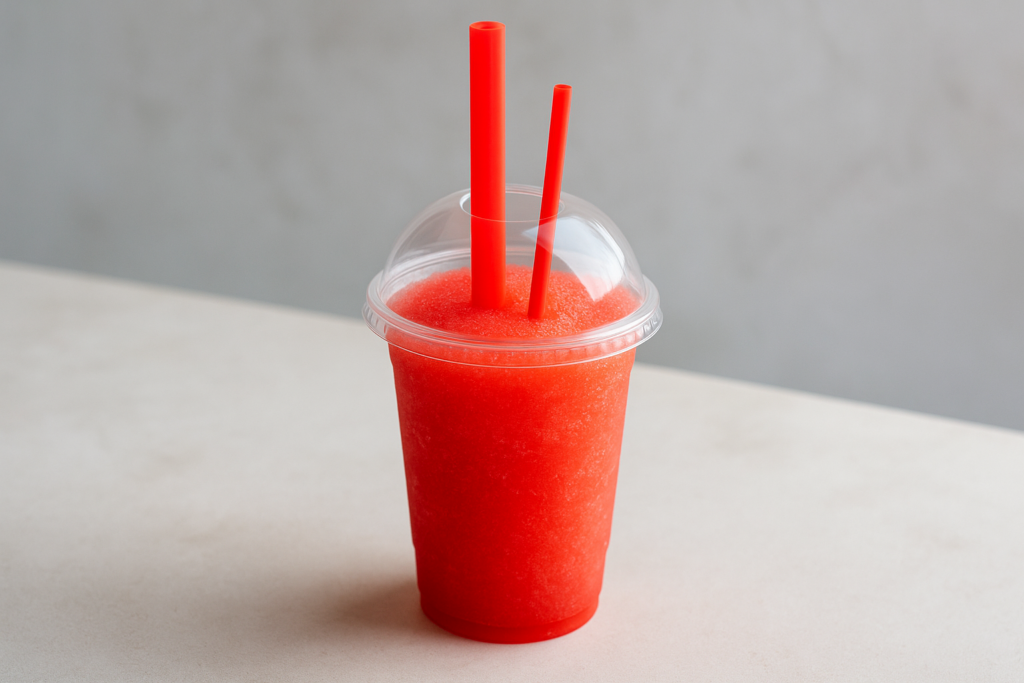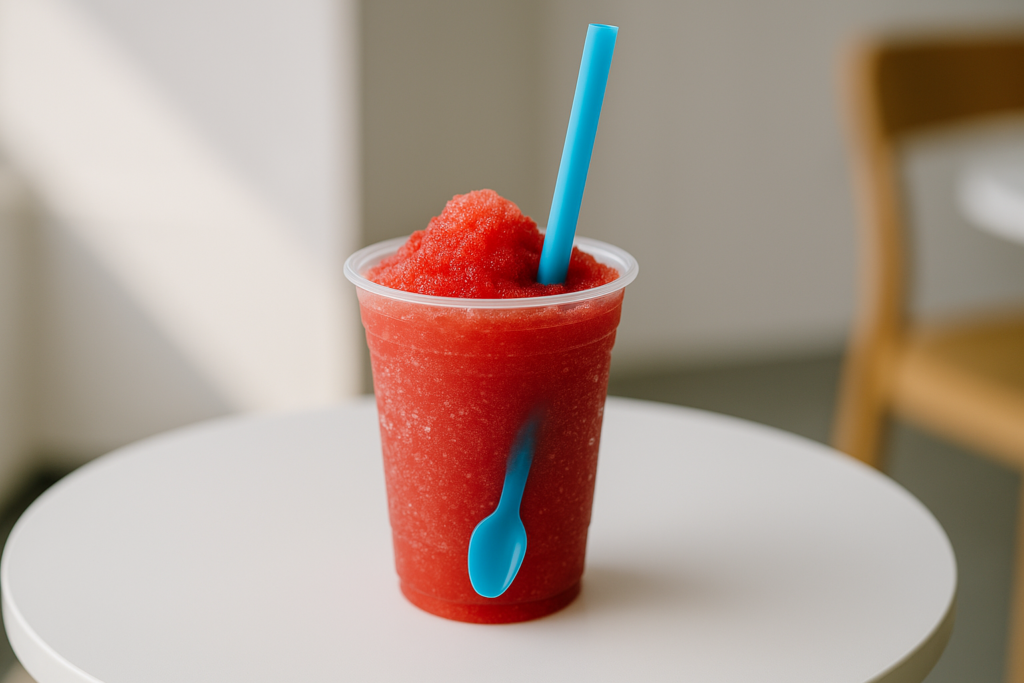
A slushy machine is not an ice maker with extra steps. It is a refrigerated cylinder with a slow-turning blade inside, and the whole thing only works because sugar refuses to let water freeze solid. Once you understand that one idea, everything else about how slushy machines work makes sense, including why your at-home attempts sometimes come out as a sad flavored ice block.
We have babysat these machines for hundreds of videos, cleaned them at 1 a.m., and broken a few in ways the manual does not cover. Here is the honest breakdown of the parts, the physics, and the mistakes.
The Short Answer
A slushy machine chills a sugary liquid to roughly 25 to 28°F (about -2 to -4°C) inside a metal barrel while an auger scrapes the freezing layer off the barrel wall and stirs it back into the mix. Instead of one solid mass, you get millions of tiny ice crystals suspended in syrup. That suspension is the slush.
The barrel is colder than the freezing point of plain water, but the sugar in the mix lowers the temperature at which the liquid can fully solidify. So the drink sits in a permanent half-frozen state, which is exactly the texture everyone is chasing.
The Physics: Sugar Is the Real Ingredient
The effect doing the heavy lifting is freezing point depression. Dissolved sugar molecules get in the way of water molecules trying to lock into an ice lattice, so the mixture needs to get colder than 32°F before it will freeze. You can read a plain-English explanation of the principle from Britannica, and it is the same reason salt works on icy roads.
Commercial mixes are usually blended to a sugar concentration of about 12 to 16 percent (roughly 13 Brix). That range is not random. It is the window where the mix freezes into soft crystals rather than either staying liquid or seizing into a brick.
- Too little sugar (under about 10 percent): the mix freezes hard, the auger strains, and the motor can trip its overload protection.
- Correct sugar (12 to 16 percent): soft, scoopable, pourable slush that holds its shape in the cup.
- Too much sugar (above roughly 20 percent): the mix never freezes properly and you dispense cold syrup.
This is why diluting concentrate with extra water to stretch a batch backfires so often. You are not making more slush, you are lowering the sugar content and pushing the mix toward ice.
Inside the Machine: The Parts That Do the Work
Whether it is a gas station Slush Puppie machine or a rental unit for a party, the internals are close to identical across brands. Here is what each part does.
- Hopper or tank: the clear plastic bowl on top that holds the liquid mix and lets customers see the product churning.
- Evaporator barrel: a metal cylinder at the bottom of the tank with refrigerant lines wrapped around or through it. This is the cold surface where ice actually forms.
- Auger or scraper blade: a spiral shaft that turns slowly, usually 20 to 40 rpm, shaving the thin ice layer off the barrel and mixing it back in.
- Compressor and condenser: the refrigeration circuit, same basic technology as your fridge, pumping refrigerant to pull heat out of the mix.
- Thermostat or consistency control: a sensor or torque-based dial that tells the compressor when the batch has reached target texture.
- Dispensing valve: a lever-operated gate at the front that lets slush out without letting warm air rush in.
The consistency control is the knob most people fiddle with. On torque-based units, the machine measures how hard the motor has to push through the mix and shuts the compressor off once resistance hits the set point.
How Long the Freeze Cycle Takes
From room-temperature liquid, most commercial units need 60 to 120 minutes for the first batch. Pre-chilling your mix in a refrigerator overnight cuts that down to around 30 to 45 minutes, which is the single easiest way to speed things up.
For a closer look at this topic, see our guide: How Often Do Slushy Machines Need to Be Cleaned?.
Related reading: Best Slushy Machines for Parties.
After the first batch, refills blend into existing cold slush and firm up in 15 to 30 minutes. Machines packed against a wall or sitting in direct sun take noticeably longer because the condenser cannot dump heat, so leave at least 6 inches of clearance on every vented side.
Commercial Machines, Home Machines, and Slushy Cups
All three make slush, but they get there differently, and the difference shows up in texture.
Home countertop units
Consumer machines, including the popular Ninja slushie machine, use the same barrel-and-auger concept in a smaller footprint with faster micro-chilling and tighter software control. They typically handle 60 to 88 ounces and finish a batch in 15 to 60 minutes depending on the preset. They are pickier about recipes than commercial units because there is less mass to buffer a bad sugar ratio.
Slushy cups
Those squeeze cups do not refrigerate anything. A gel layer sealed between the inner and outer wall gets frozen solid in your freezer for 4 to 6 hours, then the cold gel pulls heat out of the drink while you squeeze and stir. It works for one small serving and then needs to be refrozen, so it is a party trick rather than a machine.
Combination units
Slushie and ice cream machines exist and share the auger-in-a-cold-barrel design, but frozen dessert bases carry fat and higher solids, so the motors and barrel temperatures are built differently. Running one mix in a machine designed for the other is how expensive things start smoking.
What Actually Ruins a Batch
We have wrecked enough runs on camera to know the failure list by heart. Most bad slush traces back to one of these.
- Carbonated soda poured straight in: the churning strips the carbonation in minutes and you end up with flat, foamy slush.
- Dairy or cream: fat coats the barrel, insulates the cold surface, and spoils fast at 27°F.
- Pulp, seeds, or chunks: they jam the auger seals and clog the dispensing valve.
- Sugar-free mixes without a substitute solute: artificial sweeteners add almost no freezing point depression, so the batch turns to ice unless the recipe compensates with glycerol or sugar alcohols.
- Underfilling the tank: below the minimum fill line, the mix freezes to the barrel instead of circulating.
If you want to experiment anyway, do it with sugar-forward juices and syrups. We keep a running list of weird flavor combos that somehow work, and almost every winner had enough sugar to freeze correctly on the first try.
Keeping a Slushy Machine Running
These machines are designed to run continuously. Shutting one off overnight means the batch melts, warms into the food safety danger zone, and has to be dumped and refrozen the next morning, which costs more in product and electricity than just leaving it on.
Cleaning is the part people skip. Most manufacturers and health departments want a full teardown, wash, and sanitize of the tank, auger, seals, and valve every 2 to 3 days, with the auger seals greased with food-grade lubricant at every reassembly. Dry seals are the number one cause of leaks and dead motors.
One ingredient note worth knowing: some low-sugar slush mixes use glycerol to keep the texture soft, and the UK Food Standards Agency has issued guidance advising against slush ice drinks with glycerol for young children. If you are buying commercial concentrate, it is worth a look at the ingredient panel.
Frequently Asked Questions
Can you put any drink in a slush machine?
No. A slush machine needs a liquid with roughly 12 to 16 percent sugar and no dairy, pulp, or carbonation, or the batch will either freeze solid or never freeze at all. Juices, sports drinks, syrup-and-water mixes, and purpose-made concentrates are the safe options.
What liquid do you put in a slushie machine?
Most operators use a concentrate diluted at the ratio printed on the bottle, commonly 1 part syrup to 5 parts water. Straight fruit juice, powdered drink mix made at full strength, and flavored syrups all work as long as the finished sugar level lands in that 12 to 16 percent window.
How long can you leave a slushie machine on?
Commercial units are built to run 24 hours a day, and most operators leave them on continuously for the entire week between deep cleans. The compressor cycles on and off on its own, so a filled machine sipping power at idle uses far less energy than re-freezing a melted tank from scratch.
Is it worth buying a slushie machine?
For home use, a countertop unit in the $150 to $400 range pays off if you make slush at least weekly, since a single machine-made batch costs about $1 to $2 versus $3 to $5 per gas station cup. Commercial double-tank machines run $1,500 to $4,000 and only make sense with real volume behind them.
Want More Slush Science?
We test this stuff constantly, mostly for our sports content and the occasional experiment that belongs in the AI Slop pile. If you are making videos about it too, our notes on how often to post Shorts pair well with a machine that never turns off, and the merch shop is right there if you want to look the part while you clean an auger seal.