A slushy straw has a spoon on the end because half-frozen slush does not behave like a liquid, and a plain tube gives up on it fast. The scoop lets you dig, break up ice clumps and eat the thick part while the same piece of plastic still works as a straw for the melted part. It is one utensil doing two jobs, which is exactly why it has survived on convenience store counters for more than fifty years.
Below is the short answer, the physics behind it, the guy who is usually credited with inventing it, and the correct technique (yes, there is one).
The short answer
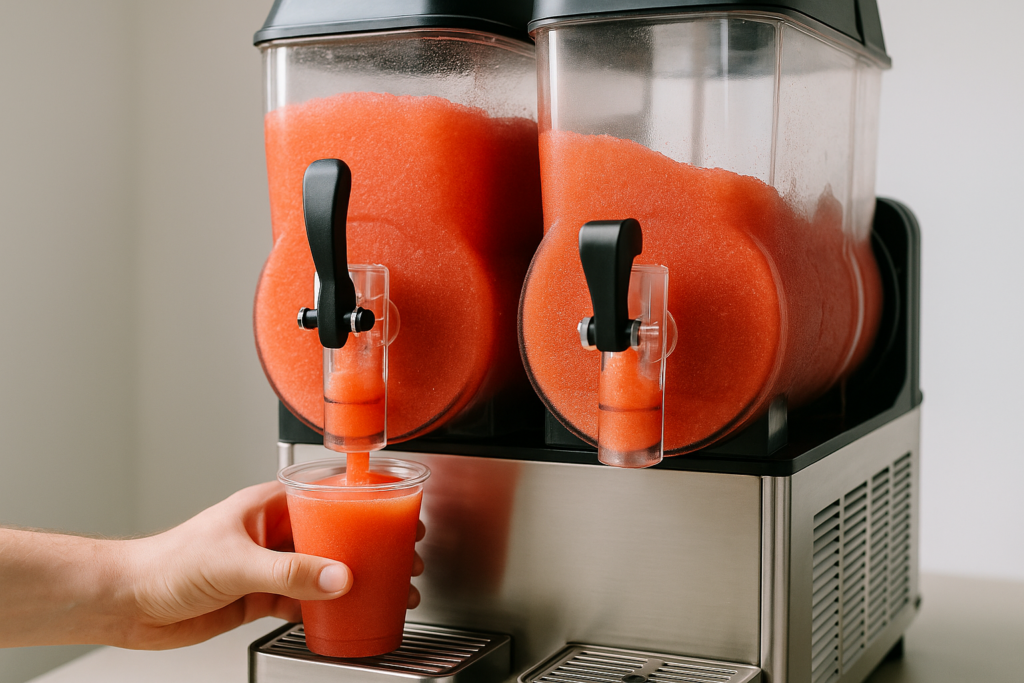
Slush is a two-phase mixture: tiny ice crystals suspended in flavored syrup and water. When you pull on a normal straw, the liquid moves and the ice crystals pack together at the bottom of the tube, forming a plug. The spoon end gives you a way to break that plug, scoop what will not travel and stir the cup back into something drinkable.
- It clears clogs. The scoop works like a tiny plunger and rake for packed ice.
- It doubles as a utensil. The top third of a fresh slushy is basically shaved ice, and you eat that part.
- It stirs. Slush separates as it melts, so a stir pulls the syrup back up off the bottom.
- It saves the store money. One item instead of a straw plus a spoon plus a lid slot for both.
Why frozen slush defeats a regular straw
Suction only works if the stuff in the tube can flow as a unit. A slushy sits right around 21 to 28 degrees Fahrenheit, cold enough that roughly a third to half of the water in the cup is locked up as ice crystals. Those crystals are small enough to enter a wide straw but large and irregular enough to jam against each other once they are inside.
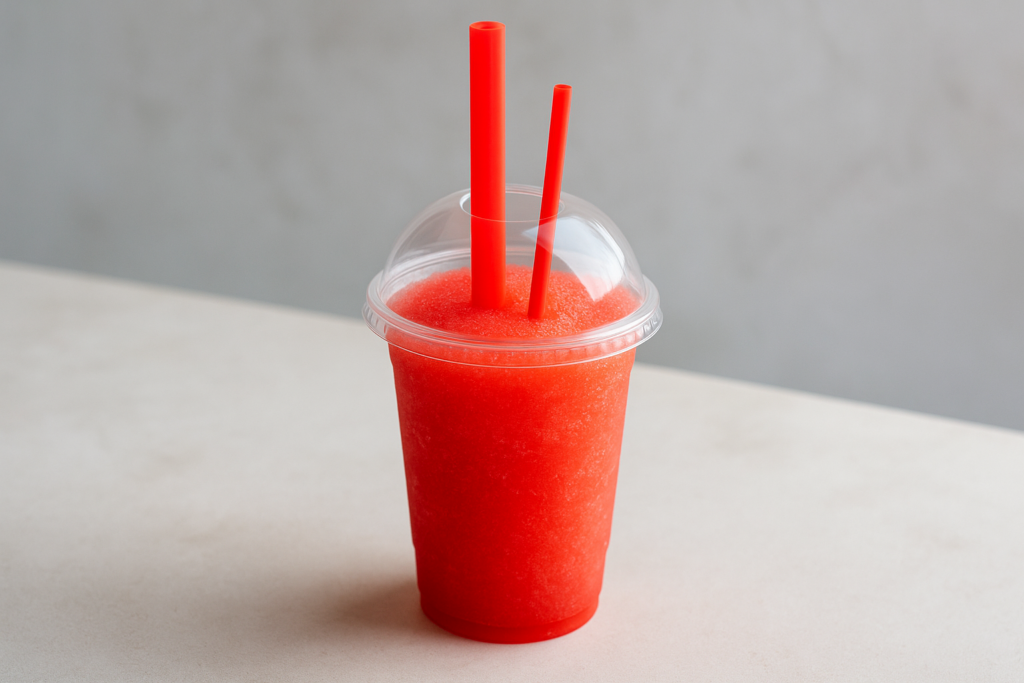
Engineers call it bridging, and you can watch it happen: the first pull is easy, the second is harder, the third gets you nothing but a red face. A skinny 5mm cocktail straw jams almost immediately, which is why slush straws run wider, usually 8 to 10mm across, with thicker walls so they do not collapse when you pull hard.
That same physics is what makes people inhale too fast once the clog finally clears, and that is how you end up with a headache. If that sounds familiar, we wrote a whole fix for it in how to stop a brain freeze fast, and the mechanism itself in why slushies cause brain freeze.
Who invented the spoon straw
The spoon straw is widely credited to Arthur Aykanian, a Massachusetts-based plastics engineer who spent his career solving straw problems and holds patents connected to bendable and specialty straws. His work landed in the late 1960s and early 1970s, right as frozen carbonated drinks were exploding across American convenience stores.
The timing was not a coincidence. 7-Eleven had named the Slurpee in 1966, and the chain needed something customers could actually finish. A plain straw generated complaints and a plain spoon meant handing out two pieces of plastic per cup, so the hybrid Slurpee spoon straw won on both fronts and never left. If you have ever wondered how those frozen carbonated drinks differ from a scooped slush, we broke it down in slushy vs Slurpee.
For a closer look at this topic, see our guide: The History of the Slushy Straw.
Related reading: Does Straw Size Actually Matter for a Slushy?.
For a closer look at this topic, see our guide: Things Every Friend Group Does During Summer.
For a closer look at this topic, see our guide: Are Slushy Straws Better Straight or Crooked?.
Anatomy of a spoon straw
Pick one up and read the design instead of just chewing on it. There are four deliberate features, and every one of them exists for a reason.
- The wide bore. Typically 8 to 10mm inside diameter so ice crystals pass instead of bridging.
- The angled scoop. Cut on a slant so it shears into packed slush rather than bouncing off it.
- The notches or slots in the scoop. These let liquid drain through while ice stays in the bowl, and they keep the tube from sealing itself shut against the bottom of the cup.
- The ring or ridge partway up. A stop that catches on the lid so the straw does not slide down into the drink or shoot out when you set the cup in a holder.
That last detail answers a question people ask constantly. The ring is not decoration and it is not a measuring line. On a spoon straw it is a lid stop, and on some designs it also marks where the paper wrapper tears cleanly.
How to actually use one (most people do it wrong)
Watching someone attack a fresh slushie with a spoon straw is like watching someone try to eat soup with a fork. There is a rhythm to it, and it goes in stages as the cup melts.
- First third: spoon only. The top is too stiff to draw through a tube, so scoop and eat it like shaved ice.
- Middle third: stir first, then sip. Fold the melted syrup at the bottom back into the ice so the flavor spreads instead of pooling.
- Final third: straw only, with the scoop resting flat so the notches stay open.
- If it clogs: pull the straw halfway out, blow one short puff back down the tube, then push the scoop into the clump and twist. Never keep pulling harder, because that is how you get a sudden gulp of 25-degree syrup.
Flavor layering matters more than people admit here, since a stirred cup tastes noticeably different than an unstirred one. If you want combinations that survive the melt without turning muddy, start with our favorite slushy flavor combinations.
Paper straws, bans and what changed
Plastic straw restrictions across several U.S. cities and states pushed manufacturers to rethink the spoon end, because paper does not hold a scoop shape once it is wet. The current workarounds are heavier wound paper with a molded tip, PLA-style compostable plastics, and reusable hard plastic or stainless versions sold as accessories rather than handed out free.
The reusable ones perform best, honestly. A stainless spoon straw does not soften, it scrapes a cup clean, and it costs less over a summer than the eleven bendy straws you would otherwise lose in the couch. Wikipedia’s overview of the drinking straw tracks how quickly the category has shifted over the past decade.
Making the straw earn its keep at home
Homemade slush tends to be icier than machine slush because home freezers do not agitate the mix while it sets, which means bigger crystals and a stiffer texture. That is precisely the situation the spoon end was built for, so keep a couple of proper spoon straws around if you make slush in a blender or a tray.
Our walkthroughs for making a slushy without a machine cover crystal size and scraping intervals, which is where most home batches go sideways. And if you would rather drink out of something with a little more personality than a gas station cup, that is what Slushy Bros exists for.
Frequently Asked Questions
Why do dentists tell you not to use a straw?
Dentists warn against straws mainly after oral surgery, because the suction can dislodge a healing blood clot and cause dry socket, usually within the first 24 to 72 hours after an extraction. Outside of recovery, a straw can actually help by keeping sugary or acidic drinks off the front teeth, though it does not eliminate the acid exposure. The American Dental Association’s MouthHealthy resource covers both sides of that in plain language.
Why do bartenders put two straws in drinks?
Two straws double the flow rate on thick drinks, which matters for anything blended, frozen or served over crushed ice. The second reason is practical: skinny cocktail straws are also stirrers, and a pair is far harder to lose in a crowded glass than one.
What are spoon straws used for?
Spoon straws are used for thick, semi-frozen or heavily iced drinks, most famously the Slurpee and other frozen carbonated beverages, plus milkshakes, bubble tea toppings and Italian ice. The scoop handles anything too thick to draw through a tube, and the tube handles everything that has melted, so you finish the cup without needing a second utensil.
Why does my straw have a ring?
The ring is a lid stop that keeps the straw from sliding down into the cup or popping up out of the lid slot, and it sits roughly two to three inches from the top on most designs. On wrapped straws it can also indicate the tear point, and on some reusable models it marks how far the straw seats into a tumbler cap.
Grab a cup worth putting a spoon straw in
We think about this stuff more than any reasonable person should, which is why our shop has cups, apparel and a few opinions about AI slop. Come pick something out and go build a slushy that needs the spoon.