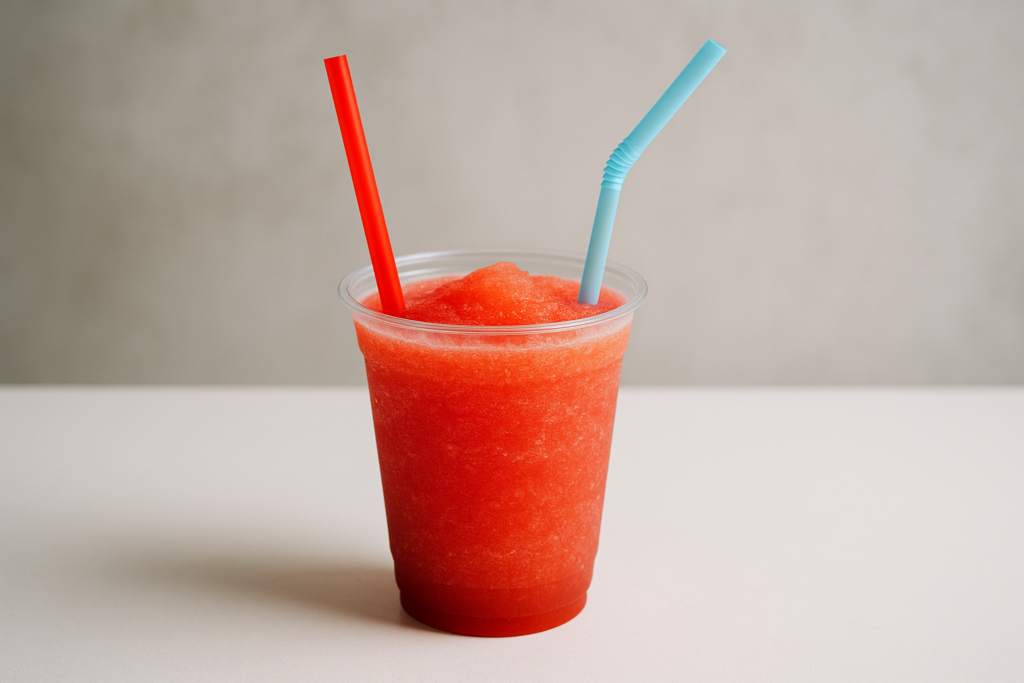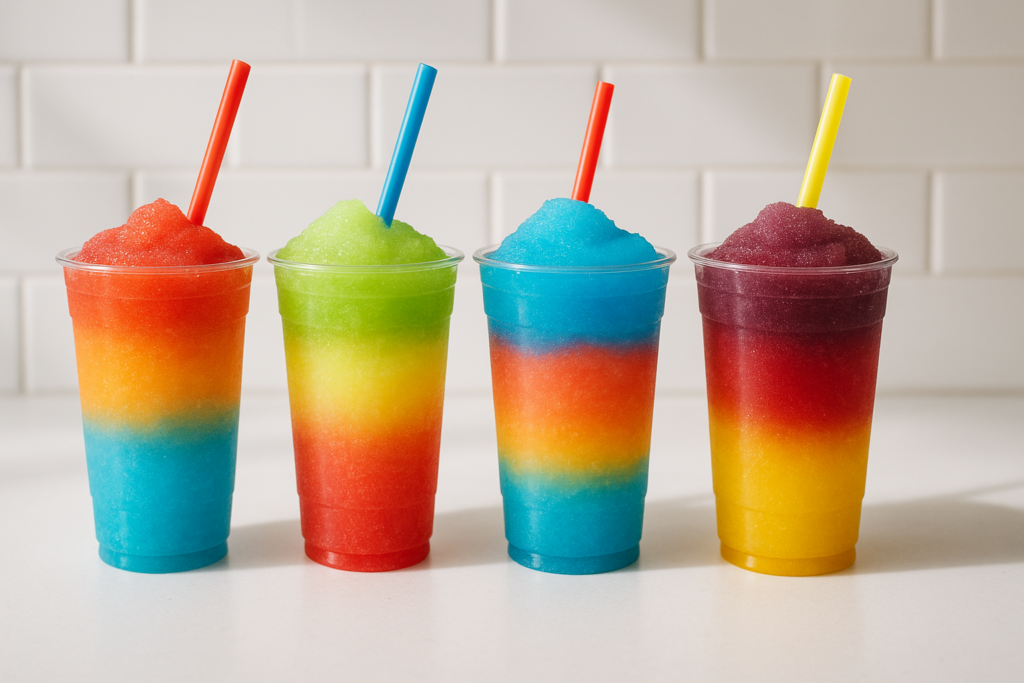
A slushy is a sweetened, flavored liquid that has been frozen only part of the way, so roughly half of it is microscopic ice crystals and the rest is still syrup. That mixture is called an ice slurry, and it is the reason a slushy pours, scoops and collapses in your straw instead of behaving like a popsicle. So when people ask what a slushy actually is, the honest answer is that it is a texture first and a flavor second.
That distinction matters more than it sounds. Get the ice crystals wrong and you have either a cup of cold juice or a solid block you have to stab. Everything below is the part nobody explains at the gas station counter.
The short answer, then the interesting one
Short version: a slushy is a frozen drink held at a temperature just below the freezing point of plain water, usually between 26°F and 29°F (about -3°C to -1.5°C). At that temperature the water in the mix has partially crystallized while the dissolved sugar keeps the rest fluid. You are drinking a two-phase suspension, which is a very unromantic way to describe the best beverage ever invented.
The interesting version is that a slushy is a controlled failure to freeze. Freeze it fully and you have ice. Do not freeze it at all and you have soda. The window where it works is narrow, maybe three or four degrees wide, which is why a good slush is genuinely harder to make than it looks.
Why a slushy never freezes solid
Sugar is the whole trick. Dissolving sugar in water lowers the temperature at which that water can crystallize, a phenomenon called freezing point depression. As ice starts forming, the remaining liquid gets more concentrated with sugar, which pushes its freezing point even lower, so the process stalls out in a self-limiting way.
Practically, that means the sugar concentration decides the texture:
- Too little sugar (under about 8% by weight) and the mix freezes hard against the barrel walls and turns chunky.
- The sweet spot sits around 11% to 13% sugar, which is close to full-strength soda syrup ratios.
- Too much sugar (past roughly 16%) and it never crystallizes properly, so you get a cold, thin, slightly sad flavored liquid.
This is also why diet slushies are so difficult. Artificial sweeteners deliver sweetness without contributing much to freezing point depression, so manufacturers add other ingredients to do that structural job. Which brings us to the ingredient panel most people never read.
What a slushy is actually made of
A commercial mix is simpler than the label makes it look. Water, sugar or high fructose corn syrup, citric or malic acid for tartness, natural and artificial flavoring, coloring, and a small amount of a freezing point modifier such as glycerol or a stabilizer gum. Carbonation is optional and mostly disappears in the machine anyway.
That last point surprises people. A slushie is not simply frozen soda, because the freezing and churning process drives off most of the dissolved carbon dioxide within minutes. What you taste as “fizz” in a Coke slush is largely acidity and cold-numbed sweetness doing an impression of carbonation.
For a closer look at this topic, see our guide: Slushy vs Slurpee: What’s the Difference?.
Flavor perception changes at these temperatures too. Cold suppresses your sensitivity to sweetness and aroma, so slush mixes are formulated noticeably sweeter and more acidic than a drink meant to be served over ice. It is the same reason airline food gets over-seasoned. If you want to argue about which of those formulations deserve respect, we ranked the best slushy flavors from elite to criminal and stand behind every take.
How a slushie machine actually works
The countertop or convenience-store version is a clear barrel with a refrigerated cylinder inside it and a rotating auger scraping the walls. Understanding it explains almost every slush problem you have ever encountered.
- Mix goes in, usually 2 to 3 gallons per barrel, diluted to the ratio printed on the concentrate box (commonly 1 part syrup to 5 parts water).
- The evaporator chills the barrel wall below freezing, and a thin layer of ice forms against it.
- The auger scrapes that layer off continuously, shattering it into crystals small enough to pass through a straw.
- Constant agitation keeps crystals from fusing, which is exactly what makes the finished product pourable.
- A thermostat or torque sensor holds the target consistency, cycling the compressor when the mixture thickens.
The first machines were an accident. Omar Knedlik, a Kansas Dairy Queen owner, had a broken soda fountain in the late 1950s and stashed bottles in the freezer, where they came out semi-frozen and customers preferred them that way. He built a machine from a car air conditioner, called the result the ICEE around 1958, and 7-Eleven licensed the concept in 1965 and renamed its version the Slurpee the following year.
Icee, Slurpee, slush puppie: the naming mess
So what is a slushy actually called? It depends entirely on where you are standing and who owns the trademark.
- Slushy or slushie is the generic American term, spelled both ways with no real consensus.
- ICEE and Slurpee are brands, not product categories, though people use them generically.
- Slush Puppie is another brand, launched in 1970, with a syrup-poured-over-shaved-ice build rather than a churned slurry.
- Slush ice drink is the regulatory phrasing used in the UK and Ireland.
- Granita in Sicily is something totally different in method, frozen slowly and scraped, with a coarser crystal.
Search interest in this question spikes on Reddit and TikTok, partly because a wave of videos in the past couple of years reframed slush as a texture experiment rather than a kids’ drink. We are not neutral parties here. Read our about page if you want the full disclosure of bias.
The glycerol conversation
If you have followed slush news at all, you have run into glycerol. It is a sugar alcohol used in some low-sugar and no-sugar slush mixes to keep the product soft without the sugar load, and it works well at that job.
In 2025 the Food Standards Agency advised that slush ice drinks containing glycerol should not be given to children aged 7 and under, and that children aged 10 and under should not have more than one. The concern is glycerol intoxication, which can cause headaches, nausea and low blood sugar in small bodies consuming a lot quickly. Full-sugar slushies made the traditional way do not rely on it.
An easy homemade slushie recipe
You do not need a machine. This easy homemade slushie recipe takes about five minutes and gets you 80% of the way to store texture.
- Combine 2 cups of ice with 1/2 cup of juice, soda or flavored syrup in a blender.
- Add 1 tablespoon of sugar if your liquid is unsweetened, since sugar is doing structural work here, not just flavor.
- Blend on high for 20 to 30 seconds, stopping while there is still visible crystal texture.
- Serve immediately, because it will separate within about 10 minutes.
The no-blender method is better if you have patience: pour the mix into a shallow metal pan, freeze it, and drag a fork through it every 30 minutes for roughly 3 hours. Four or five passes gives you a genuine granita-style crystal.
Frequently Asked Questions
What exactly is a slushie?
A slushie is a flavored, sweetened drink frozen to about 28°F so that roughly 40% to 50% of its water content exists as tiny ice crystals suspended in syrup. Constant churning keeps those crystals separate, which is what makes it drinkable through a straw rather than solid like a popsicle.
Is a slushy and an ICEE the same thing?
No. ICEE is a specific brand founded on Omar Knedlik’s machine design around 1958, while “slushy” is the generic name for the whole category, the same way Kleenex relates to tissues. Slurpee, Slush Puppie and store-brand frozen drinks are all slushies too.
Are slushies just frozen soda?
Not usually. Most slushies are made from a dedicated concentrate diluted with water, and even when soda is used, the freezing and churning process releases most of the carbonation within a few minutes. The perceived fizz in the finished cup comes mainly from added acidity.
Is a slushy a solid or liquid?
Technically both: it is a two-phase mixture of solid ice crystals suspended in a liquid sugar solution, which engineers call an ice slurry. It flows like a liquid under pressure but holds a soft mound in a cup, which is why the straw has to be so aggressively wide.
Grab a cup and dress for the occasion
Now that you know a slushy is technically a suspended crystal matrix, you may as well drink one in an appropriate outfit. Browse the apparel lineup or check the gifting picks for the person in your life who takes frozen drinks a little too seriously, and see why graphic tees are taking over again while you decide.