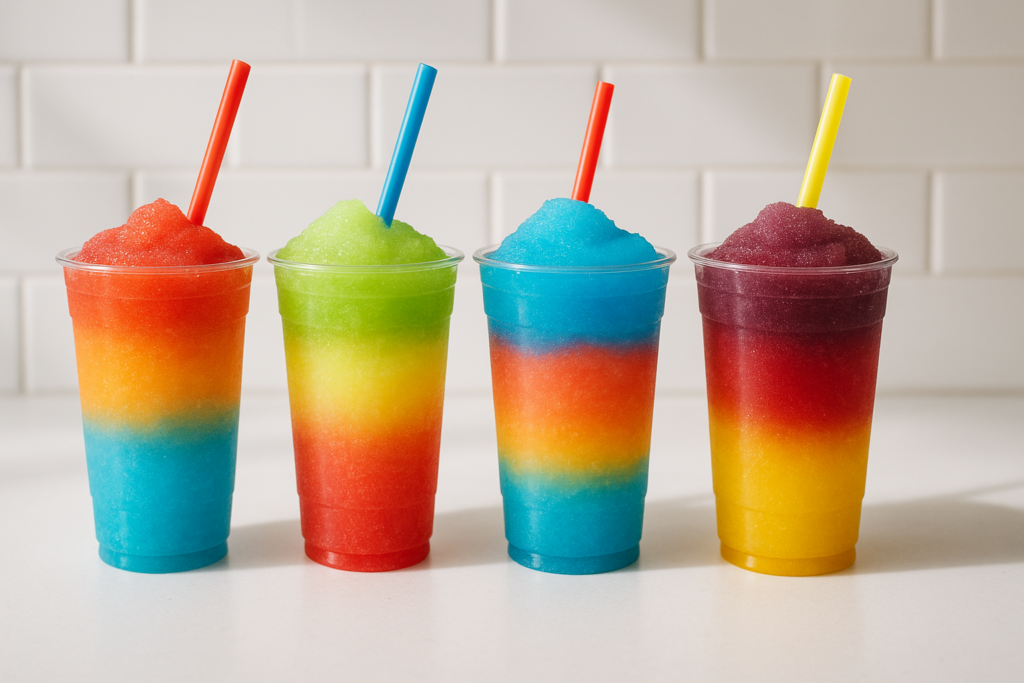
Are slushy straws better straight or crooked? For thick, properly frozen slush, straight wins almost every time, because a straight tube gives frozen crystals a clear path and loses less suction pressure along the way. Crooked (bendy) straws still have their place, mostly for thinner drinks, car cup holders and anyone who does not want to lift a 32 ounce cup to their face.
That is the short answer. The longer answer involves fluid dynamics, straw diameter, lip temperature and a slightly unhinged kitchen test we ran with five straws and one very cold cup.
First, What Counts as a “Crooked” Straw?
People use “crooked” to mean a few different things, and the distinction matters more than you would expect. Before arguing about which is best, it helps to know which shape you are actually holding.
- Straight straw: one continuous tube, no articulation, usually 6 to 10 mm wide.
- Bendy (articulated) straw: a ribbed accordion section near the top that lets the straw hold a 90 to 120 degree angle.
- Pre-bent straw: a fixed elbow, common in reusable metal and glass sets, with no ability to straighten out.
- Spoon straw: the classic slushy tool, straight, wide bore, with a scoop cut into the bottom end.
Most of the online argument, including the long are slushy straws better straight or crooked threads on Reddit, collapses once people admit they are comparing a wide straight spoon straw to a narrow bendy one. Diameter is doing a lot of the work in that comparison.
The Physics: Why a Bend Costs You Slush
Drinking through a straw is just pressure work. You drop the pressure inside your mouth, atmospheric pressure pushes the drink up the tube, and anything that adds resistance in that tube makes you work harder for the same mouthful.
Two factors dominate. The first is bore size, and it is not close. Flow through a tube scales with the fourth power of the radius, so moving from a 6 mm straw to a 10 mm straw multiplies flow by roughly seven times at the same suction. That is why a wide straight straw feels effortless and a skinny one feels like punishment.
The second factor is bends. In engineering terms, a sharp 90 degree elbow carries a minor loss coefficient of roughly 0.3 to 1.0, meaning some of your suction is spent pushing fluid around the corner instead of up the tube. With water it is barely noticeable. With slush it absolutely is, because ice slurry is shear-thinning and semi-solid, and crystals love to pile up right where the tube changes direction.
The clog problem
Anyone who has tried to drink a fresh slushy through a bendy straw knows the feeling: you pull hard, nothing moves, and then a plug of ice releases all at once and detonates against the roof of your mouth. That plug forms at the accordion ribs. The interior ridges create tiny catch points where ice bridges across the tube, and once one crystal wedges, the rest stack behind it.
Related reading: One Hole or Two? The Great Straw Debate.
Related reading: How to Unclog a Slushy Straw Without Losing Your Mind.
We cover this topic in more depth in Paper vs Plastic Straws: Which Is Better for Slushies?.
Related reading: Does Straw Size Actually Matter for a Slushy?.
Our Very Unscientific Kitchen Test
Nobody in the top search results actually tested this, so we did. Same batch of slush at the same texture, five straws, 30 second timed pulls, three rounds each, one deeply committed volunteer.
- 10 mm straight spoon straw: fastest by a wide margin, zero clogs, minor brain freeze casualties.
- 8 mm straight plastic straw: close second, smooth flow, no ice bridging.
- 10 mm pre-bent stainless steel: decent flow, but the elbow held a slug of half-melted slush between sips.
- 6 mm bendy straw, bent: two clogs in three rounds, noticeably more effort per sip.
- 6 mm bendy straw, left straight: better than the bent version, still slow because of the narrow bore.
The pattern was boring and clear. Width first, straightness second, everything else a distant third. If you want to know why the spoon end keeps showing up on the winners, we broke that down in why a slushy straw has a spoon on the end, and the shape has a longer backstory than most people assume, which we covered in the history of the slushy straw.
When the Crooked Straw Actually Wins
Bent straws are not a mistake. They were designed in the 1930s so hospital patients could drink lying down, and that use case never went away. A few situations where crooked beats straight:
- Deep cup holders: a bend lets you sip a 44 ounce cup wedged in a console without unbuckling anything.
- Melted slush: once your drink is 20 minutes old and mostly liquid, the bend costs you almost nothing.
- Kids and toddlers: the angle reduces spills and makes tall cups manageable.
- Limited mobility or recovery: drinking without lifting or tilting the cup is the entire reason the bendy straw exists.
- Lids with side ports: some travel tumblers only work with an angled straw.
So the honest verdict is contextual. Straight for the first ten minutes when the slush is at peak texture, crooked for the long tail of the drink. If you are curious how quickly that texture window opens, our notes on how long a slushy takes to freeze explain why the first few minutes matter so much.
Material Matters More Than Shape
Once you have settled on a straight, wide straw, the next question is what it should be made of. This is where the reusable straw debate gets loud, and where the answer really does depend on what you drink.
- Plastic: still the best disposable straws for thick slush. Wide bores are cheap, the walls are thin, and the material does not conduct cold into your lip.
- Paper: environmentally tidy, structurally doomed after about 15 minutes in ice.
- Stainless steel: durable and dishwasher friendly, but metal straws are bad for frozen drinks in one specific way. Stainless conducts heat roughly 15 to 20 times better than plastic, so the mouthpiece drops to slush temperature fast and your lower lip pays for it.
- Glass: the nicest mouthfeel of any reusable straw, easy to inspect for cleanliness, breakable if you are the kind of person who drops things.
- Silicone: soft, safe for kids, flexible enough to bend or straighten as needed.
\in
If you already own steel, metal straws with silicone tips solve most of the cold-lip problem for a couple of dollars. A travel straw with a case is worth it if you actually carry one, and a reusable straw from Walmart works as well as a boutique one as long as the interior diameter is 9 mm or wider and a cleaning brush comes with it.
The brain freeze tradeoff
Wide straight straws deliver more cold slush to the roof of your mouth per second, which is exactly the mechanism behind cold-stimulus headache, formally classified by the International Classification of Headache Disorders. Faster flow means more fun and more risk. Pace yourself, or read how to stop a brain freeze fast before your next 32 ounce decision.
Frequently Asked Questions
Are straight or bent straws better?
Straight straws are better for thick drinks like slushies, milkshakes and boba, while bent straws are better for thin liquids sipped from a fixed cup. In our timed test, a straight 10 mm straw moved slush noticeably faster than the same drink through a bent 6 mm straw, which clogged twice in three rounds.
What is the right way to use a bendy straw?
Extend the accordion section fully before you bend it, aim for roughly a 90 to 120 degree angle, and keep the bend above the liquid line. Stretching the ribs first smooths the interior wall, which reduces the catch points where ice and pulp tend to bridge across the tube.
Why do dentists tell you not to use a straw?
The main warning is after oral surgery: most dentists ask you to skip straws for 24 to 72 hours because suction can dislodge the blood clot and cause a dry socket. Outside of recovery, straws are often recommended for acidic and sugary drinks since they limit enamel contact, as the American Dental Association explains on MouthHealthy.
What type of straw is better?
For frozen drinks, the best reusable straw is a straight glass or silicone-tipped one with a 9 to 12 mm bore, because width matters more than material or shape. Many people prefer stainless steel for durability, and it is fine for iced coffee, though the cold transfer makes it the weakest choice for slush.
Grab a Straw Worth Keeping
We think about this stuff more than is reasonable, which is roughly the whole premise of Slushy Bros. If you know someone who would argue about straw geometry at a backyard party, our gifting picks and the rest of our links page are a decent place to start.