In the paper vs plastic straws debate, slushies are the hardest test either material will ever face. A slushy is cold enough to stiffen your fingers, thick enough to fight back when you pull on it, and slow enough to sit in your cup for twenty minutes while the straw quietly dissolves or holds firm. Here is how each one actually performs, plus what the environmental tradeoff really looks like once you stop repeating headlines.
The short answer
For pure performance, a rigid plastic straw wins on a thick slushy: it keeps its shape, it resists collapsing under suction, and a wide-bore version moves semi-frozen slush without you straining. Paper straws work fine for thinner, more melted slushies but tend to soften somewhere between the 8 and 15 minute mark, depending on wall thickness and how hard you pull.
For environmental impact, the picture flips, though not as cleanly as either side likes to claim. Paper breaks down faster in the environment and is easier to compost, while plastic lasts for centuries if it escapes the waste stream. The most defensible option for most people is neither: a reusable straw you actually remember to bring.
Why a slushy is harder on a straw than any other drink
Soda is basically water with bubbles in it. A slushy is a suspension of ice crystals in flavored syrup, and that mixture behaves more like wet sand than like a liquid. Pulling it up a narrow tube takes real negative pressure, and that pressure is what crushes weak straws.
Three things make slushies uniquely punishing:
- Suction load. A thick slush can require several times the vacuum of a soda, which flattens paper walls and kinks thin plastic.
- Dwell time. Nobody slams a slushy. It sits, which gives moisture time to work into paper fibers and adhesive seams.
- Cold condensation. The outside of the straw gets wet too, so paper is soaking from both directions while your hand grips it.
That is why straw geometry matters as much as material. We have argued about this at length in our breakdown of whether slushy straws work better straight or crooked, and the same physics applies here: every bend, seam or narrow point is a place where flow slows and pressure spikes.
Paper straws: where they hold up and where they fold
Modern paper straws are far better than the mushy 2018 versions that turned the whole internet against them. The good ones use three or four plies of food-grade paper wound at a tight spiral, and they will handle a standard slushy for a reasonable stretch. The cheap ones are two-ply, and they are why the reputation stuck.
What paper does well:
- Breaks down quickly if it ends up somewhere it shouldn’t, typically weeks to months rather than centuries.
- Compostable in many municipal programs, assuming no plastic lining.
- No sharp edges if a kid chews the end, which happens roughly every single time.
- Grippy texture that does not slide down into the cup the way smooth plastic does.
What paper does badly:
We cover this topic in more depth in Best Gas Station Slushies Ranked.
- Softens under sustained suction, usually first at the bite point near your lips.
- Narrow bores are common, and a narrow straw plus thick slush equals a collapsed tube.
- Flavor transfer. Some people taste cardboard by minute ten, and it is not imaginary.
- Cannot scoop. Paper is hopeless as a spoon end, which matters more than you’d think once the slush thickens.
There is also a wrinkle worth knowing. Several paper straws are coated to resist moisture, and a 2023 study out of Belgium found per- and polyfluoroalkyl substances (PFAS) in the majority of paper straw brands tested. “Plant-based” does not automatically mean coating-free, so if that matters to you, look for straws that specifically state no PFAS and no plastic lining.
Plastic straws: fast, sturdy and complicated
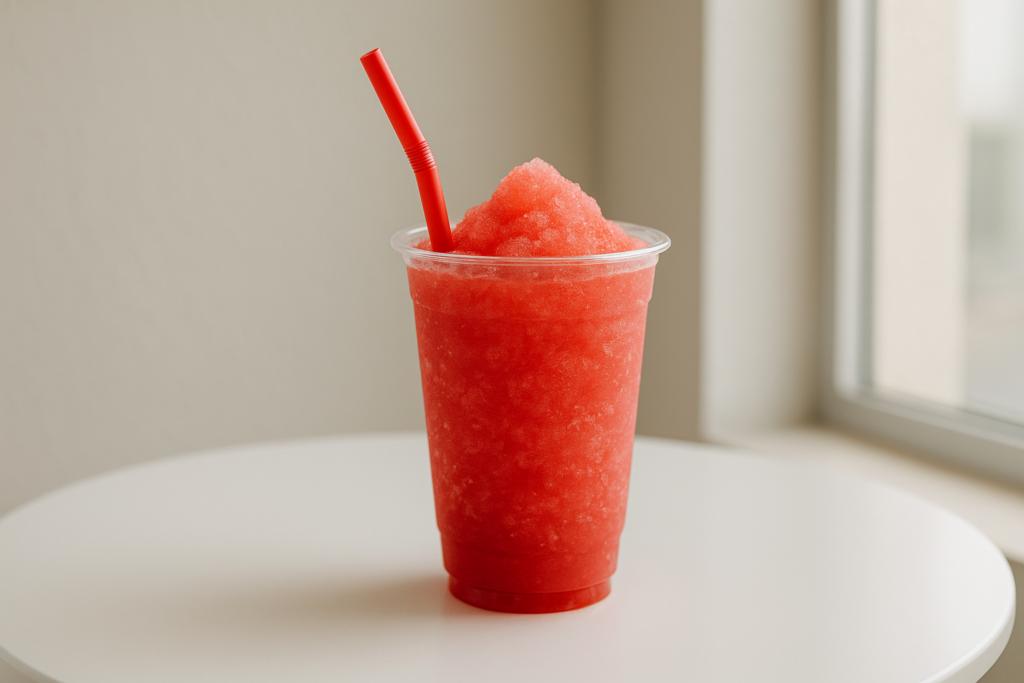
A polypropylene slushy straw is genuinely well-engineered for the job. It is wide (most run 8 to 12 mm compared to 6 mm for a standard soda straw), it holds its shape under vacuum, and the classic spoon tip lets you attack the frozen chunk at the bottom. If you have ever wondered why that little scoop exists at all, we went down that rabbit hole in this post about the spoon-ended slushy straw.
The performance case is straightforward:
- No structural failure over a 30 minute drink, even with aggressive suction.
- Wide bore moves semi-frozen slush without the jaw workout.
- Neutral taste from start to finish.
- Cheap per unit, which is why venues default to them.
The problem is what happens after the last sip. Straws are consistently among the most-collected items in coastal cleanups, and single-use plastics are a major share of marine debris tracked by NOAA’s Marine Debris Program. They are also too small and too light to sort reliably at most recycling facilities, so even conscientious recycling usually ends with them in landfill.
The environmental math, honestly
Straws are a small slice of total plastic waste, often cited at well under 1 percent by weight. That statistic gets used to argue the whole debate is theater, which is a bit of a dodge, because weight is the wrong measure for an item that floats, fragments and gets eaten by wildlife.
On the other side, paper is not free. It takes more energy and water to manufacture per straw, and a paper straw sent to landfill in an oxygen-poor environment does not compost neatly. The EPA’s work on trash-free waters is a decent primer on why disposal pathway matters more than material alone.
The honest summary: if the straw ends up in a proper waste system, the difference is modest. If it ends up in a river, paper wins by a wide margin. Since nobody can guarantee where their straw lands, paper carries the lower worst-case risk.
The alternatives worth considering
- Reusable plastic (PP or Tritan): the best slushy performance available, wide bore, spoon tips common, dishwasher safe. Best overall if you’ll actually wash it.
- Stainless steel: durable and easy to clean, but it conducts cold aggressively, which makes brain freeze more likely and sensitive teeth miserable.
- Silicone: soft, kid-safe, no temperature shock, but it collapses slightly under heavy suction on very thick slush.
- Glass: looks great, tastes neutral, and is a bad idea anywhere near a pool deck or a backyard game.
- PLA “bioplastic”: behaves like plastic but only composts in industrial facilities, which most towns do not have. Read the label before you feel good about it.
Bore size is the deciding factor across every one of these, which is a hill we’ve already died on in our look at whether straw size actually matters.
How to make a paper straw survive a full slushy
- Let the slushy sit 2 to 3 minutes before the first pull so the top layer loosens slightly.
- Use short, steady pulls instead of one long heroic drag, which is what crushes the walls.
- Rotate the straw every few minutes so one side isn’t constantly soaked and bitten.
- Don’t chew the tip. Bite damage is the failure point in most collapsed paper straws.
- Ask for a spare up front. A second straw costs the venue almost nothing and saves the last third of your drink.
Our verdict, by situation
- Thick, fresh-from-the-machine slushy: plastic, or better, a reusable wide-bore straw.
- Slushy you’re nursing for half an hour: reusable, every time. Paper will not make it.
- Kids’ party or anywhere near grass and water: paper, because lost straws are guaranteed and paper loses gracefully.
- Backyard tournaments and chaos: reusable with a spoon tip. If you’re planning that kind of day, our Backyard Olympics planning guide covers the rest of the logistics.
- You forgot your straw entirely: whatever the venue has. Drinking it out of the lid is not a personality.
Frequently Asked Questions
How long does a paper straw last in a slushy?
Most three-ply paper straws stay usable for 8 to 15 minutes in a standard slushy, and cheaper two-ply versions can soften in under 5. Thicker slush and harder suction shorten that window, because the failure usually starts at the bite point rather than the submerged end.
Are plastic straws actually better for thick slushies?
Yes, on performance. A rigid straw with an 8 to 12 mm bore moves semi-frozen slush with roughly half the effort of a 6 mm paper straw, and it will not collapse under vacuum no matter how hard you pull.
Do paper straws contain plastic or chemicals?
Many do. A 2023 Belgian study detected PFAS in about 90 percent of the paper straw brands it sampled, typically from moisture-resistant coatings, so look for straws explicitly labeled PFAS-free and unlined if that concerns you.
Can slushy straws be recycled?
Rarely. Straws are usually too small and light to be sorted by standard municipal recycling equipment, so most end up in landfill regardless of the bin they go in, and uncoated paper straws are better sent to compost.
What is the best straw for a slushy overall?
A reusable wide-bore straw with a spoon tip, ideally polypropylene or Tritan rather than steel. It handles the thickest slush, avoids the cold-shock issue metal creates, and eliminates the disposal question entirely after a few dozen uses.
Bring your own cup to the argument
If you’re going to have opinions about straws this strong, you may as well have the right vessel underneath one. Have a look at My Cup or browse the rest of the Slushy Bros shop and settle the paper vs plastic thing on your own terms.