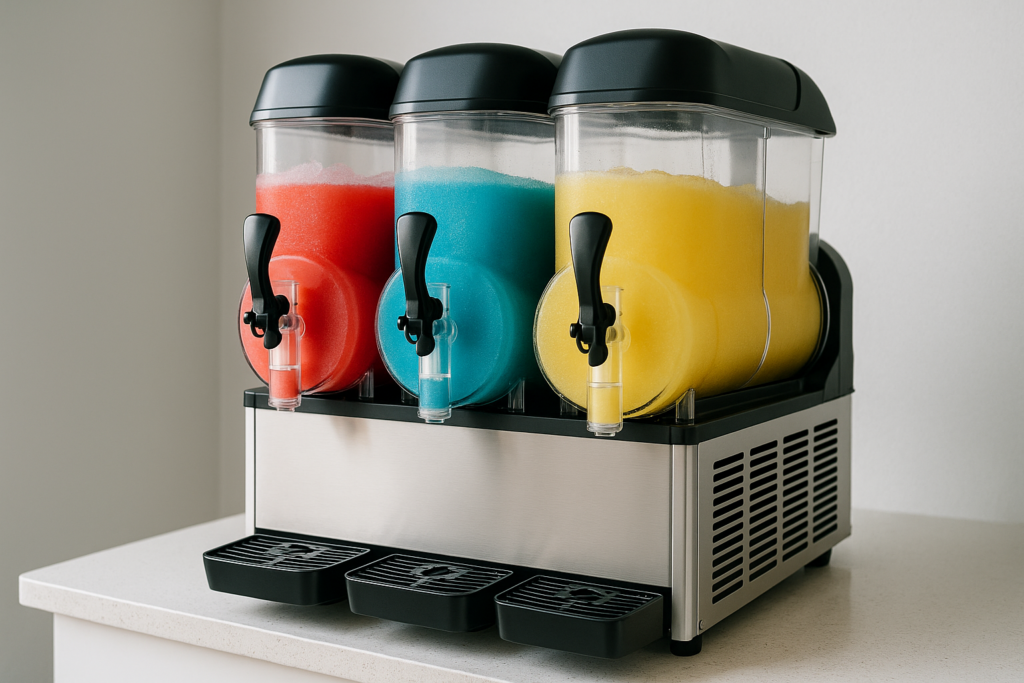
A commercial slushy machine is basically four things stacked together: a clear plastic hopper, a stainless steel freezing cylinder hidden behind it, a spiral auger that never stops turning, and a refrigeration system pulled straight out of a mini fridge. Everything else is seals, sensors and a control board telling those parts when to work harder. Once you know what’s in there, the weird stuff (why it stalls, why it goes watery, why cheap syrup wrecks it) stops being mysterious.
Four Parts Do Almost All the Work
Strip the panels off any gravity-fed commercial slushie machine and you find the same core layout, whether it says Taylor, Bunn, Elmeco or a no-name import on the front. The bowl you see is maybe 20% of the machine.
- Hopper (bowl): clear polycarbonate, usually 2 to 3 gallons (about 8 to 12 liters) per bowl, holding the liquid mix before and during freezing.
- Evaporator cylinder: a stainless steel tube at the back of the bowl, wrapped in refrigerant tubing, chilled to roughly 20 to 25 degrees Fahrenheit.
- Auger: the plastic or stainless spiral turning inside that cylinder at 12 to 30 RPM, scraping ice crystals off the wall.
- Compressor and condenser: the noisy bit underneath, pumping refrigerant and dumping heat out the back or side vents.
That’s the whole trick. Liquid touches a freezing wall, forms crystals, and the auger shaves them off before they can lock into solid ice. If you want the physics side of it in more depth, we broke that down separately in how slushy machines work.
The Auger and the Ice Layer It Fights
The auger is the part people underestimate. It has scraper blades along its outer edge, and those blades ride within a millimeter or so of the cylinder wall, peeling off a thin sheet of ice on every rotation.
That scraped ice gets folded back into the warmer liquid in the middle of the bowl, which is why a good slush looks like it’s slowly churning rather than spinning fast. The auger also whips a small amount of air into the mix, called overrun, typically 10 to 25% in a gravity machine. More overrun means lighter texture and a slightly bigger serving yield from the same syrup.
When an auger’s blades wear down or the bearing at the front of the shaft goes dry, the scraping gets sloppy, ice builds on the cylinder wall, and the motor starts working against a solid block. That is the number one reason a machine that worked fine last summer suddenly hums and refuses to freeze.
The Refrigeration Side Nobody Sees
Behind the bowls sits a closed refrigeration loop that would look familiar to any HVAC tech. A hermetic compressor (commonly 1/3 to 1/2 horsepower per bowl) pressurizes refrigerant, the condenser coil and fan dump that heat into the room, and a capillary tube or expansion valve drops the pressure so the refrigerant boils inside the evaporator wrapped around the cylinder.
Most machines built since about 2020 use R-290 (propane) rather than older HFC blends, in charges under 150 grams, because it runs efficiently at these temperatures and has a very low global warming potential. The EPA’s SNAP program is what pushed that switch across commercial refrigeration equipment in the US.
Two practical things follow from all that hardware. Air-cooled condensers need 6 inches of clearance and a clean coil, or the machine loses freezing capacity fast in a hot kitchen. And that same coil is why a unit parked in direct sun at an outdoor event takes 90 minutes to freeze instead of 45.
Gearbox, Motor and the Sensor That Decides When You’re Done
Each bowl has its own drive: a small AC gear motor, a reduction gearbox full of oil, and either a direct coupling or a magnetic drive connecting to the auger shaft. Magnetic drives are nicer because they slip instead of snapping the auger when something jams.
We cover this topic in more depth in How Much Does a Slushy Machine Cost?.
The smarter commercial units then add a torque sensor or current-sensing board. Instead of a thermostat guessing at temperature, the control board watches how hard the auger motor is pulling. Thicker slush means more drag, more drag means more current, and at a set threshold the compressor cycles off and holds the product right there. That feedback loop is the difference between consistent texture all day and a bowl that swings between soup and cement.
Cheaper machines skip it and run on a simple thermostat plus a timer, which works until your mix ratio changes or the room heats up.
Seals, Gaskets and the Parts That Actually Fail
Service calls almost never involve the compressor. They involve rubber. Every bowl has a shaft seal where the auger passes into the back wall, a large bowl gasket, a spigot with its own O-rings, and a drip tray underneath that catches whatever those parts leak.
- Auger shaft seal: replace every 6 to 12 months; a leak here drips sticky syrup into the gearbox area.
- Bowl gasket: shrinks and hardens with heat cycles, usually good for a year or two.
- Spigot O-rings and valve body: the most touched, most sugar-crusted part on the machine.
- Auger bearing: needs food-grade lubricant on every reassembly, not petroleum grease.
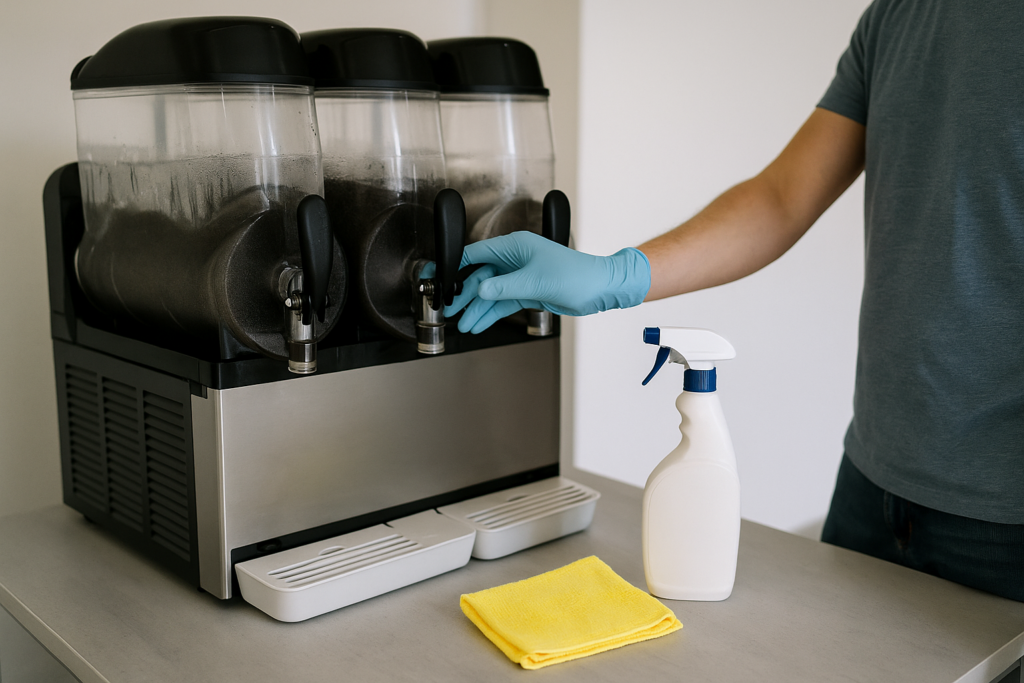
All of those get inspected during a full teardown clean, which manufacturers typically call for daily or at least every few days depending on the mix. The FDA Food Code uses 24 hours as the baseline interval for frozen dessert equipment unless the manufacturer’s validated procedure says otherwise. We go deeper on realistic schedules in our post on how often slushy machines need to be cleaned.
Sugar Is a Component, Not an Ingredient
Here’s the part most buying guides skip: the mix is functionally part of the machine. Slush stays slushy because dissolved sugar lowers the freezing point of water, so the liquid sits in a slurry state instead of turning into a solid puck.
Commercial slush concentrate is designed to land around 12 to 16 Brix (roughly 13% sugar by weight) once diluted, usually at a 5:1 or 6:1 water-to-syrup ratio. Go too dilute and the bowl freezes into a block that stalls the auger. Go too sweet and it never sets, staying a cold sticky liquid all afternoon.
Alcohol behaves the same way, only stronger. A daiquiri machine or alcohol slushie machine built for commercial use generally wants finished product in the 8 to 14% ABV range, with plenty of sugar to balance it. Push past 15% and the freezing point drops below what the cylinder can reach. Diet or sugar-free mixes need a formulated blend with glycerin or extra solids, which is why plain diet soda rarely freezes properly. We covered that tradeoff with the best sodas for the Ninja SLUSHi.
Gravity-Fed vs Pressurized: Two Different Machines Inside
There are really two types of commercial slush machine, and their guts barely resemble each other.
- Gravity-fed (open bowl): the clear-hopper units you see at convenience stores and rental companies. Mix is poured in the top, gravity feeds the cylinder, and product pours out a front spigot. Easiest to clean, easiest to flavor-swap, typically $1,200 to $3,000 for a single bowl and $2,500 to $6,000 for a double or triple.
- Pressurized / post-mix: the ICEE and Taylor slush machine style. Syrup, filtered water and CO2 meet at a mixing block, get pumped into a sealed stainless barrel, and carbonation plus pressure drive the product out. No visible bowl, higher output, far more plumbing, and a price that usually runs $8,000 to $20,000 or moves through a lease.
Countertop home units like the Ninja SLUSHi use the same auger-and-cylinder concept in miniature, with a smaller compressor and a pre-set program instead of a torque board. Same physics, smaller everything, one flavor at a time.
Frequently Asked Questions
How much does a commercial slushie machine cost?
Most gravity-fed commercial machines run $1,200 to $3,000 for a single bowl and $2,500 to $6,000 for two or three bowls, while pressurized ICEE-style or Taylor units typically start around $8,000 and climb past $20,000. Refurbished double-bowl machines often sell in the $900 to $1,800 range, though you should budget for a fresh set of seals and an auger immediately.
What liquid goes in a slushie machine?
Any liquid with roughly 12 to 16% dissolved sugar works, which covers commercial slush concentrate diluted 5:1, juice blends, regular soda and sweetened cocktail mixes. Plain water, coffee without sugar and most diet sodas will either freeze solid or never thicken, because there is nothing in them to depress the freezing point.
Is a slushy business profitable?
Ingredient cost for a 16 ounce slush is usually 25 to 50 cents against a $3 to $6 sale price, so gross margins of 80% or better are normal. The real variables are electricity (a double-bowl machine draws 600 to 1,000 watts and runs all day), labor for daily cleaning, and how many cups you actually move per hour at your location.
Can you put any drink in a slush machine?
No. Carbonated drinks lose their fizz in an open-bowl machine, dairy needs equipment rated for it, and anything above about 15% ABV will not freeze at the cylinder’s operating temperature. Pulp, seeds and thick purees also jam the auger and chew up the shaft seal, so strain anything with solids before it goes in the hopper.
Come Hang With the Slushy Bros
We drink a lot of slush and film most of it, from game day setups to the questionable experiments that end up on the channel. Check out the blog for more machine breakdowns, or grab a cup and join the crew.