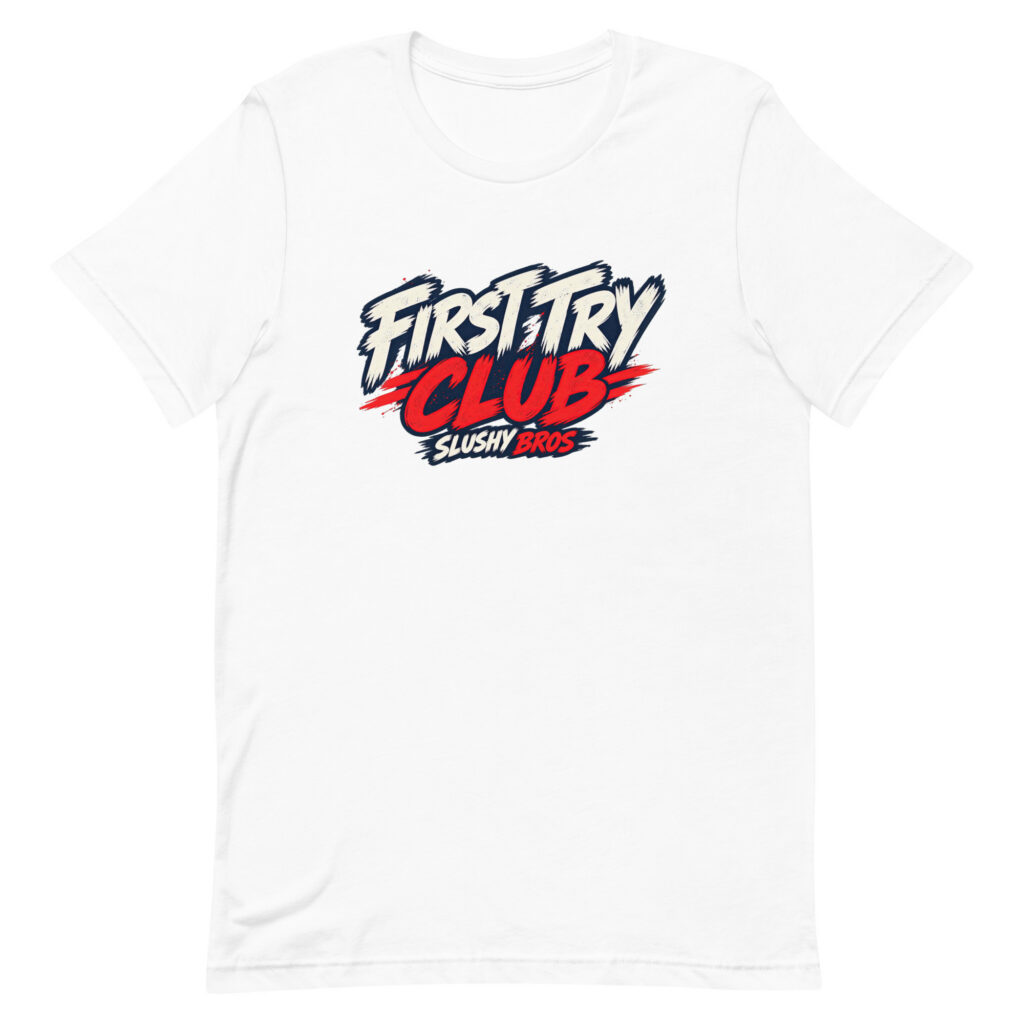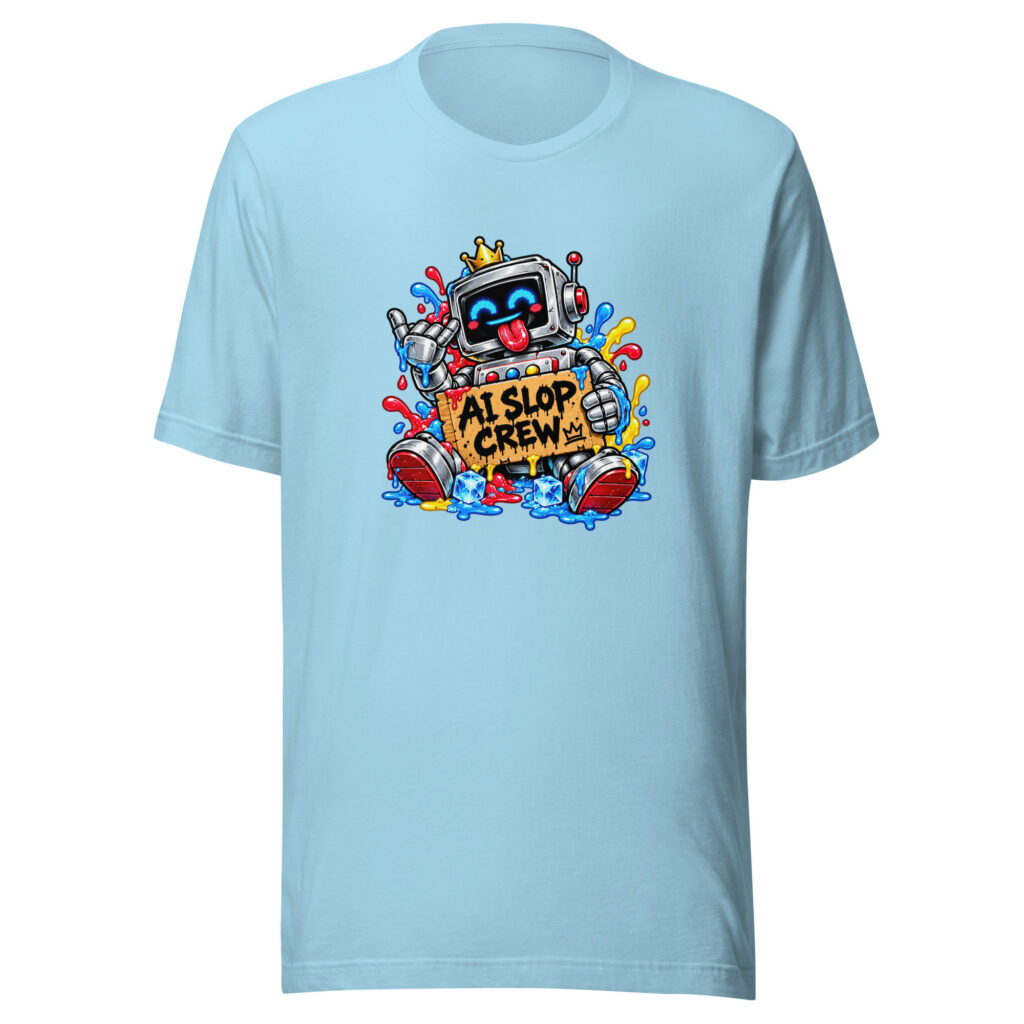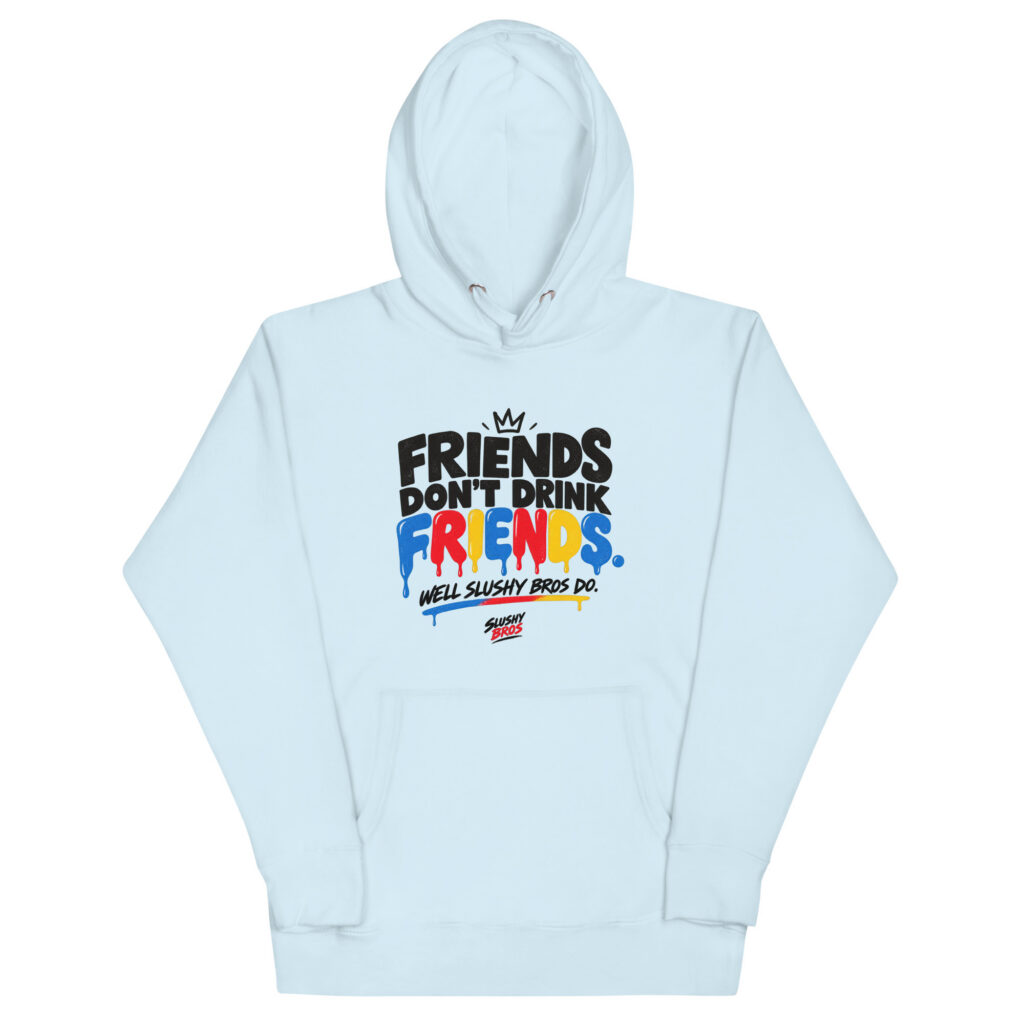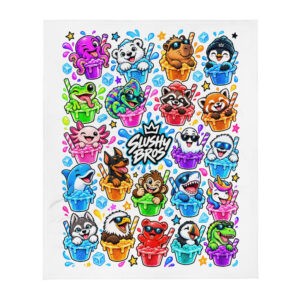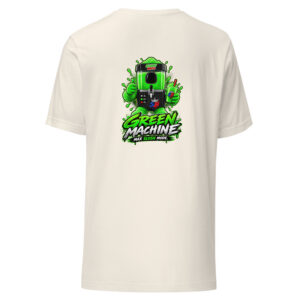
A channel name printed across the chest of a cheap blank is the fastest merch you can possibly make, and it is usually the first thing in somebody’s closet to get demoted to yard-work duty. That is the exact outcome we keep trying to dodge with Slushy Bros clothing. We would rather make a shirt somebody wears because they like the shirt, and only later finds out it came from a channel about three guys in slush costumes.
This is less a branding philosophy and more a reaction to buying a lot of bad merch ourselves over the years. We know what a 4.3-ounce tee feels like after six washes.
The Test We Use: Does the Shirt Work Without the Channel?
Every design goes through one question before anything else. If a stranger saw this on a person at a grocery store, with zero context, would it read as a shirt or as an advertisement?
Advertisements get worn twice. Shirts get worn until they fall apart. That gap is most of what separates good creator apparel from the stuff that gets bought during a hype window and never leaves the drawer.
In practice it means a few things we hold ourselves to:
- No logo slapped at 11 inches wide just because the print area allows it.
- The joke carries the design, and the branding sits small, usually on a sleeve, hem or back neck.
- No QR codes, no “subscribe” text, no handles printed anywhere a person has to look at all day.
- It has to survive being funny once, which is harder than it sounds for anything born out of a 20-second video.
What “YouTuber Merch” Usually Means in 2026
The default creator merch pipeline is print-on-demand, and it exists because the math is friendly. A creator uploads a logo, a fulfillment partner prints on a mid-weight blank, and the creator keeps roughly $4 to $9 per shirt with no inventory risk at all.
Nobody should be mad about that. It is a reasonable way to test demand, especially for a channel that just crossed its first big subscriber milestone and has no idea whether ten people or ten thousand want a shirt.
The problem is what the model optimizes for. Print-on-demand rewards volume of designs, not quality of any single one, so you end up with the same artwork offered in a dozen shapes and colors. Fans searching for Slushy Noobz merch or anything from a similar channel run into the same grid of near-identical listings.
Blanks Matter More Than Print, and It Is Not Close
Print quality is mostly solved in 2026. Modern DTG and screen printing both hold up fine if the operator is competent. The variable almost nobody talks about is the garment underneath.
Here is the shorthand we use when we evaluate a blank:
- Weight: anything under about 150 gsm (roughly 4.3 oz) goes semi-transparent and loses shape quickly. We look at 180 to 220 gsm for standard tees, and 240 gsm or heavier for the boxy fits.
- Yarn: ring-spun or combed cotton instead of open-end, because the hand feel difference is obvious within about three seconds of touching it.
- Construction: side-seamed, with a ribbed collar that has some recovery left after being pulled over a head a hundred times.
- Certification: blanks tested to something like OEKO-TEX Standard 100, which screens finished textiles for harmful substances.
A heavier, better-constructed blank typically costs us $4 to $8 more per unit than the budget option. That is the single largest cost decision in the whole product, and it is the one customers feel every time they put the thing on.
We cover this topic in more depth in How to Grow a YouTube Channel From Zero.
Related reading: How to Style a Slushy Bros Graphic Tee Without Looking Like You’re Wearing Merch.
Scarcity Is a Sales Tactic, Not a Design Decision
The 48-hour drop is everywhere in creator apparel, and it works, which is why it is everywhere. TikTok’s own tagline is “make your day,” and a lot of merch really is designed for about that long: one spike of attention, one day of urgency, then dead stock.
We are not interested in running clothing that way. If a design is good in March it is still good in November, and telling somebody they have three hours to decide is a weird way to treat a person who just wants a frozen-themed tee that fits.
There are exceptions. Things tied to a specific bit, a collab, or a subscriber milestone giveaway have natural end dates, because the moment itself ends. That is different from manufacturing panic.
Where the Designs Actually Come From
Almost nothing starts in a design file. It starts as a line somebody said in the backyard that the other two could not stop repeating for a week. We wrote a whole breakdown of that pipeline in how a video joke becomes a t-shirt, and the short version is that most ideas die at the sketch stage.
The ones that survive have a specific quality: they are funny to someone who has never watched a single video. Friends Don’t Drink Friends is the clearest example we have. It reads as a joke on its own, and the channel context is a bonus layer rather than the entire point.
Our sports-themed pieces follow the same rule. If you have to explain the shirt at a cookout, we picked the wrong idea.
What We Put a Sample Through Before It Ships
Every design gets a physical sample before anything goes live, and the sample gets treated badly on purpose. This is the part of the process that adds two to four weeks to a launch and prevents most of the complaints.
- Ten wash cycles at normal household settings, including a couple of dryer runs, checking for print cracking and collar stretch.
- Measurement check after washing, because shrinkage over about 5 percent in the body length makes a size chart useless.
- Three different body types wearing it for a full day, since fit on a flat lay tells you almost nothing.
- Daylight photos next to the digital proof, because print colors drift on heather and pigment-dyed fabrics more than people expect.
We also think about the end of the garment’s life. Americans generate millions of tons of textile waste annually, and EPA data on textiles shows most of it still goes to landfill. A shirt somebody keeps for five years is a better environmental outcome than a thin one they replace twice a year.
The Name Confusion Thing
We get messages from people looking for Slushy Noobz, and we understand why. Similar word, similar energy, similar corner of the internet. If you landed here searching for Slushy Noobz merch and this is not what you wanted, no hard feelings at all.
If you are here on purpose, the fastest way to figure out whether our stuff is for you is to watch a couple of clips on our Instagram first. The clothing makes a lot more sense after about ninety seconds of video.
Frequently Asked Questions
Does Slushy Noobz Have Merch?
Slushy Noobz is a separate channel from Slushy Bros, so any Slushy Noobz merch would be sold through their own official links, not ours. We mention it because the names get mixed up constantly in search, and we would rather send someone to the right place than take an accidental order.
How Do YouTubers Get Their Merch Made?
Most creators use one of three routes: print-on-demand (no inventory, roughly $4 to $9 profit per shirt), bulk screen printing with a local shop (usually 24 to 50 unit minimums and better margins), or a merch partner that handles design, production and shipping for a revenue share. Smaller channels almost always start with print-on-demand because the upfront cost is close to zero.
Why Does Creator Merch Cost $30 for a Plain T-Shirt?
A mid-weight printed tee typically carries $12 to $18 in blank, print and fulfillment costs before anyone makes a dollar, which is how $28 to $35 retail prices happen. Heavier blanks and multi-color prints push that higher, and anything sold at $20 is almost certainly on the thinnest garment available.
Do You Restock Sold-Out Designs?
Yes, for anything that is part of the core lineup, usually within four to eight weeks depending on the blank supply. Pieces tied to a specific video moment or collab are the exception, since reprinting those forever stops making sense once the bit is over.
Do I Need to Watch the Channel to Get the Shirt?
No, and that is the whole design brief. Every graphic has to land as a standalone joke first, with the Slushy Bros connection working as a second layer for people who already read the lore explainer.
Look Through the Shirts We Actually Kept
The Slushy Bros lineup is small on purpose, because most designs do not survive the sample stage. Have a look at what made it through and pick the one you would still wear if the channel disappeared tomorrow.