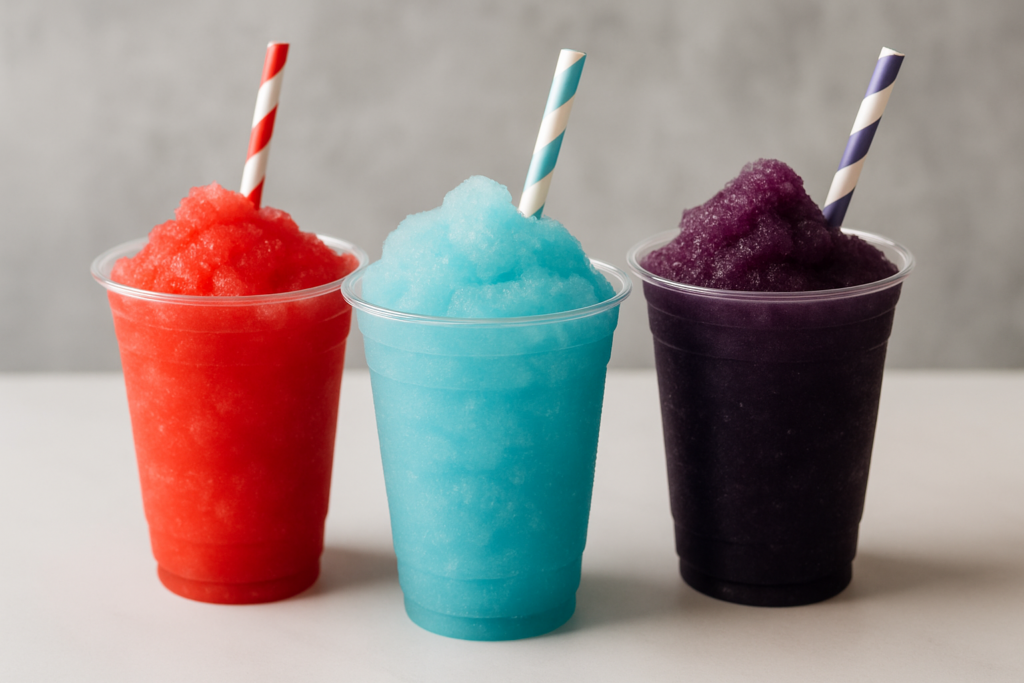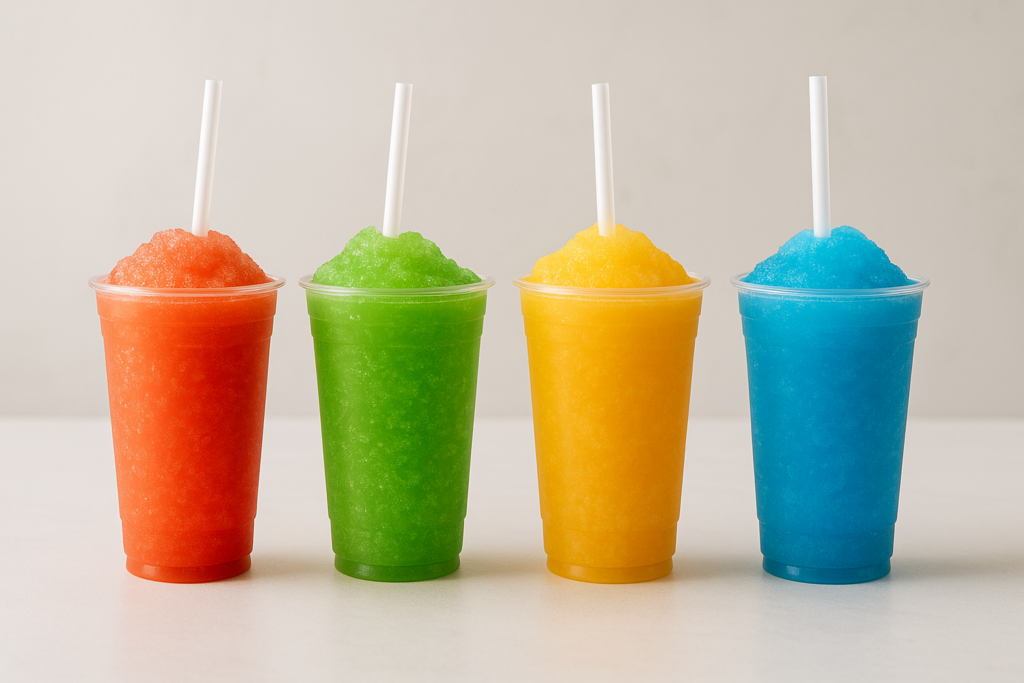
The weirdest slushy flavors ever made are not accidents. Somebody in a test kitchen tasted pickle brine over crushed ice, nodded, and sent it to production. This is a tour of the strangest frozen drinks that have actually existed, plus the reason chains keep building flavors that sound like a dare.
We are not ranking these by how gross they are. We are ranking them by how far they sit from the blue raspberry baseline that most of us grew up on.
What Actually Makes a Slush Flavor Weird
Weird is not the same as bad, and that distinction matters once you start reading flavor lists with any seriousness. A slushy earns the weird label when it breaks one of three unwritten rules.
- It is savory or sour instead of sweet. Pickle, chamoy, corn and anything with salt in the top three ingredients.
- It has no fruit behind it. Cereal, cotton candy, bubble gum and dessert flavors that exist only as lab-built aroma compounds.
- It is named after a color or a cartoon, not a taste. If you cannot guess what it tastes like from the name, that is a deliberate choice.
Most of the entries below break at least two of those at once, which is why they stuck in people’s memories long after the limited run ended.
The Weirdest Slushy Flavors Ever Made
1. Pickle Juice Slush
Sonic put a pickle juice slush on the menu in the summer of 2018, and the internet lost its composure for about six weeks. It is genuinely briny, genuinely sour, and served over the same fine ice as the cherry version. Athletes swore by it for cramping, everyone else treated it as a bet they lost, and it remains the single most requested discontinued item any time someone searches for the best Sonic slush flavors.
2. Chamoyada
A raspado layered with chamoy, Tajín and often a tamarind straw is standard at Mexican paleterias across Texas, California and Arizona, and it is still the most interesting frozen drink most Americans have never ordered. Mango or strawberry base, chile-lime dust on top, salty-sour syrup running down the cup. It tastes like four contradictory things at once and somehow works better than any single-note flavor on a drive-thru menu.
3. Tiger’s Blood
No tiger, no blood, and no agreement on what is actually in it. The consensus recipe is watermelon plus strawberry plus coconut, which makes it one of the few snow cone flavors named for a vibe rather than an ingredient. It has been a shaved ice staple since the 1980s and still confuses every first-timer who reads the flavor board at a county fair.
4. Froot Loops and Cereal-Milk Slushes
Cereal flavors made the jump to frozen drinks because the aroma compounds are easy to reproduce and the nostalgia does the rest of the selling. Froot Loops slush tastes like the milk at the bottom of the bowl, which is either the best or worst sentence in this article depending on your childhood. Fruity Pebbles and Cinnamon Toast Crunch versions have shown up at regional shaved ice chains too.
5. Flavors Named After Creatures
Baby Narwhal, Shark Bait, Mermaid, Dinosaur and Mischievous Mini-Puft are all real menu items somebody has ordered. They are mostly blue, mostly some combination of raspberry, citrus and cotton candy, and mostly designed so a seven-year-old points at the picture instead of reading the description. The weirdness is in the branding rather than the liquid, but it counts.
6. Banana
Banana slushy divides rooms faster than any other flavor we have tested. Artificial banana leans on isoamyl acetate, an ester that smells more like the Gros Michel banana varieties from decades ago than the Cavendish you buy today, which is why it reads as fake to a lot of people. Blended with strawberry it is excellent. On its own it is a commitment.
7. Holiday Flavors Like Elf Cherry Lime
Seasonal slush flavors exist because a red-and-green layered cup photographs well in December, not because anyone was demanding peppermint over crushed ice. Elf Cherry Lime, candy cane and gingerbread versions rotate through convenience stores every winter. We have opinions about cold drinks in cold weather, which we laid out in our take on the best slushy flavors for winter.
8. Soda Crossovers Like Baja Blast Freeze
Taco Bell’s frozen Baja Blast turned a fountain drink into a frozen one and proved that you do not need a new flavor at all, just a new texture. Mountain Dew, Fanta and Dr Pepper have all had frozen versions. Purists argue the carbonation loss ruins it, and they are about 30 percent right.
Related reading: How We Come Up With Slushy Bros Video Ideas.
For a closer look at this topic, see our guide: The Official Slushy Bros Flavor Tier List.
9. Melon Soda, Calpis and Matcha
Japanese convenience stores run frozen melon soda in a bright green that does not occur in nature, plus Calpis (a cultured milk drink) and unsweetened matcha versions. The melon one tastes like a very specific childhood in Osaka. It is a reminder that the American flavor lineup is narrower than we think.
10. The Alcohol Tier
Frosé, wine slushies at roadside stands, the Bushwacker on the Gulf Coast and frozen Bloody Marys all qualify as weird slushies by any honest definition. The frozen Bloody Mary in particular is tomato juice, horseradish and celery salt served at 28 degrees. Somebody made that on purpose, and a lot of people ordered it twice.
Why Chains Keep Inventing Strange Flavors
Weird flavors are cheap marketing. A limited-run slush costs a syrup formulation and a signage change, and if it goes viral the chain gets a month of free attention that would otherwise cost seven figures in paid media. Failure is also survivable, since the item disappears in six weeks either way.
There is also a supply-side reason. Flavor houses develop hundreds of compounds a year, and frozen drinks are a forgiving delivery system because ice, sugar and dilution smooth out rough edges that would be obvious in a still beverage.
If you want to see how far that logic goes when nobody is supervising, our AI Slop experiments are exactly that idea taken past the point of good judgment.
The Science: Cold Ruins Flavor, So Brands Overcorrect
Temperature changes how your tongue works. Research published in Nature found that the TRPM5 ion channel involved in sweet taste is temperature-sensitive, meaning sweetness registers more weakly when a drink is very cold.
That is why a slushy syrup tastes cloying at room temperature and merely sweet in the cup. It is also why weird flavors work better frozen than you would expect: sour, salty and bitter notes get flattened along with everything else, so pickle brine over ice is far more drinkable than pickle brine in a glass.
The practical takeaway is that a slush needs roughly 25 to 30 percent more flavor concentration than a chilled drink to land the same. Brands know this, which is why the strange ones are often the loudest ones.
How to Judge a Weird Flavor Before You Commit
We run every strange cup through the same four checks, and it saves a lot of wasted money at the counter.
- Read the base. If the first ingredient is a fruit you recognize, the weird part is probably a topping and you will be fine.
- Check the color against the name. A flavor named after an animal is a color decision, not a taste decision.
- Ask for a half-and-half. Most crews will split the cup with cherry or blue raspberry, which turns a risky order into a survivable one.
- Judge it at the halfway mark. The first three sips of anything strange taste like shock. By sip ten your palate has adjusted and you get an honest read.
For the safer end of the spectrum, we broke down the most popular slushy flavors in America and then argued about all of them again in our ranking from elite to criminal.
Building Your Own Weird Flavor at Home
Home experiments beat waiting for a chain to bring something back. Start with a 4:1 ratio of frozen base to syrup, freeze in a shallow pan and scrape every 30 minutes, or run it in a blender with a small amount of liquid. Salt is the underused variable: a pinch sharpens fruit flavors the same way it does in cooking.
Our full guide to making slushies at home covers the freezing curve in detail, and if you are testing weird combinations on camera, the Creators page is where we collect the ones worth filming.
Frequently Asked Questions
What are some unique slushie flavors?
Chamoyada, Tiger’s Blood, Froot Loops, melon soda and pickle juice are five of the most genuinely unique slushie flavors that have been sold commercially. Most chains rotate 3 to 6 limited-run flavors a year, so availability changes seasonally and by region.
What are some of the weirdest Slurpee flavors?
7-Eleven has run well over 100 Slurpee flavors since the 1960s, including bubble gum, piña colada, tangerine, and international-only versions like melon soda in Japan and lychee in Taiwan. Most last 4 to 8 weeks before the machines are switched to something else.
Is there antifreeze in Slurpees?
No. The confusion comes from the machine, not the drink: frozen beverage machines use a sealed refrigerant circuit that never touches the product. Some foods do contain food-grade propylene glycol, which the FDA lists as an approved additive and which is chemically distinct from the toxic ethylene glycol used in car radiators.
Who made the first slushy?
Omar Knedlik is credited with inventing the frozen carbonated drink in the late 1950s in Coffeyville, Kansas, after his soda fountain broke and he stored bottles in the freezer. The machine became the ICEE, and 7-Eleven licensed it in the mid-1960s before renaming its version the Slurpee.
Got a Flavor Idea That Sounds Illegal?
Send it to us and we will probably try it, because that is roughly how the last three videos started. Grab something from the Slushy Bros apparel shop while you are here and wear the evidence.