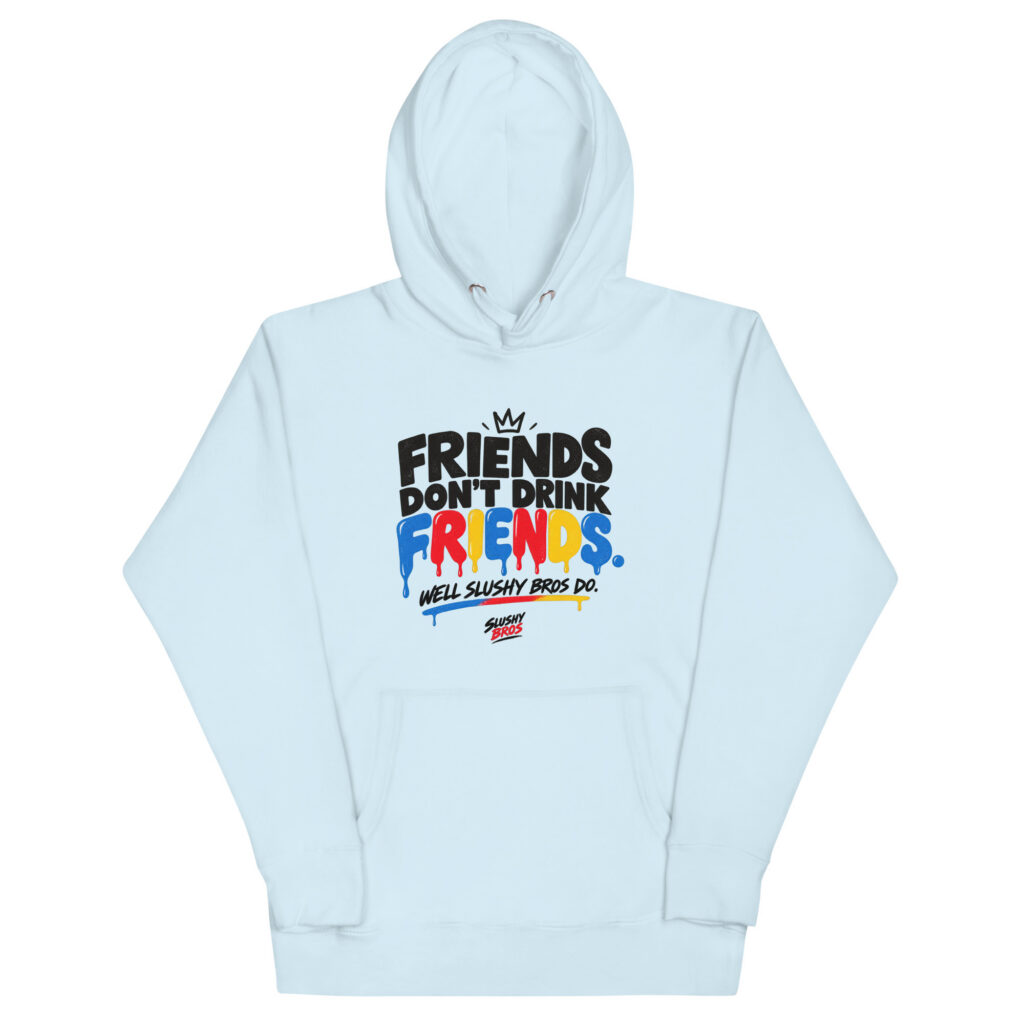
The phrase Friends Don’t Drink Friends started as a line yelled across a backyard by a guy dressed as a giant frozen drink, roughly four seconds before someone tried to put a straw in him. It is a flip of the old Ad Council line about drinking and driving, except in our version the stakes are different: the drink has feelings, a face, and a name. The shirt exists because that joke refused to die.
People ask about it more than anything else we make, usually some version of “wait, is that a real thing?” It is. Here is where the line came from, why we printed it, and what we got wrong the first time.
The Backyard Moment That Produced the Line
We had three slushy costumes, a cooler, and no plan beyond filming something stupid before the ice melted. Somebody went to grab a drink out of the cooler while Blue was standing right there, in full costume, watching. The line came out as a defense, not a punchline.
That first take is still in our camera roll and the audio is mostly wind. We reshot it twice that afternoon because the delivery kept getting worse the more we thought about it, which is a pattern we have written about in our origin story about three costumes and zero plan. The best version was still the accident.
What made it stick was the logic underneath it. If a slushy is a character, then drinking a slushy is an act with moral weight, and the whole bit writes itself from there.
The 1983 Slogan It Flips
“Friends don’t let friends drive drunk” came out of an Ad Council campaign launched in 1983, and it worked well enough that the phrasing became a template for about four decades of parody. You have seen a hundred variations of it on bumper stickers and brewery walls.
The structure is sturdy because it sets up an in-group and a rule in six words. Our version keeps the cadence and swaps the victim, which is the only change the joke needs. The original campaign is also genuinely effective public messaging, and traffic safety data from NHTSA still tracks the problem it was built to address, so we are riffing on the format rather than the message.
We are not the first people to parody it and we will not be the last. We just happened to have costumes.
Why We Printed It Instead of Letting It Die in a Group Chat
Most of our lines live and die inside a text thread. This one kept coming back in comments, usually typed out by people who had watched a clip once and remembered the phrasing better than they remembered our handle.
Three things pushed us to actually print it:
- It reads from across a room. Six words, no logo required, no context needed for the first laugh.
- People were already quoting it wrong. We saw “friends don’t drink friends” written out in at least four different punctuation styles under one video, which told us it had escaped the channel.
- It works without the costumes. A shirt that only makes sense if you have seen 20 videos is a shirt nobody buys as a gift.
We built a whole page around the bit at Friends don’t drink friends. Well Slushy Bros do. because the line needed somewhere to live that was not just a product listing. That page is the full version of the joke with the asterisk attached.
Blue Is the Reason the Joke Has Stakes
A slogan about not drinking your friends only lands if one of your friends is, technically, a drink. Blue fills that role without ever explaining himself, which is most of the appeal.
We have never clarified whether Blue is a person in a costume, an actual beverage with a personality, or something worse. Our running list of unanswered questions lives in Meet Blue, and we add to it more often than we subtract. The ambiguity is doing real work: the shirt is funnier when the reader is not sure what the rule is protecting.
Kids read it as a cartoon. Adults read it as a bar joke. Both groups are correct and we are not refereeing.
How the Shirt Is Actually Made
The first run was a mistake we learned from. We printed on a thin 4.2 oz poly blend because it was cheap, the ink sat on top like a sticker, and the print cracked on a few of them inside two months.
Current version, for anyone who cares about the boring details:
- Fabric: 100% ringspun cotton at roughly 5.3 oz, preshrunk, so it moves maybe half a size after the first wash instead of two.
- Print method: screen printed on larger runs, DTG on small and odd sizes, because screen printing 11 shirts is not economics, it is a hobby.
- Sizing: standard unisex S through 3XL, cut a little boxy, which most people size down for if they want it fitted.
- Placement: centered chest, about 3 inches below the collar, big enough to read at conversational distance.
Wash it inside out in cold water and skip the dryer when you can. That single habit is the difference between a print that lasts 18 months and one that lasts five years, and it applies to every piece in the apparel lineup, not just this one.
Where the Shirt Does Well and Where It Does Not
Tailgates are the natural habitat. The joke is fast, everybody around you already has a drink in hand, and nobody needs the setup explained. Backyard parties run a close second, especially the kind where somebody dragged a frozen drink machine onto the patio.
It does less well at a work function where you have to then explain what a Slushy Bro is to someone from accounting. We have heard that story more than once and it never gets shorter.
The one place it consistently overperforms is as a gift. People buy it for the friend who quotes things, and our gifting page exists mostly because that pattern showed up in order notes before we planned for it.
What the Line Taught Us About Merch in General
The lesson was not “print your catchphrases.” Plenty of our catchphrases would make terrible shirts, including two we tested and quietly stopped reordering.
The ones that work share a shape: they are short, they carry an implied story, and they do not require a logo to be funny. A shirt is a one-second read on a stranger’s chest, so anything needing a second clause is already too slow. That filter has killed more ideas than it has approved, which is probably the point.
We also stopped printing anything we would not wear ourselves to a grocery store. Low bar, surprisingly useful.
Frequently Asked Questions
What Does Friends Don’t Drink Friends Mean?
It is a six-word flip of the 1983 Ad Council slogan “friends don’t let friends drive drunk,” rewritten for a world where the drink is a character with a name. In Slushy Bros terms it means you do not put a straw in Blue, no matter how hot it is outside. The “well, Slushy Bros do” follow-up is the part that admits we break our own rule constantly.
Is the Shirt a Real Product or Just a Bit?
It is a real product, printed on 5.3 oz ringspun cotton in sizes S through 3XL. The bit came first by about seven months, and we only printed it after the line kept showing up in comments from people who had seen a single clip.
How Much Does the Shirt Cost?
Most of our tees sit in the $28 to $34 range, which is typical for small-batch screen printed cotton rather than blank-and-heat-press pricing. Drops are limited, so sizes sell through unevenly and the middle sizes usually go first.
Can I Get One for Free?
Yes, we give merch away every time the channel crosses another 10,000 subscribers, and the details live on the giveaway page. Entries reset each milestone, so missing one round does not disqualify you from the next.
Does the Design Change Between Drops?
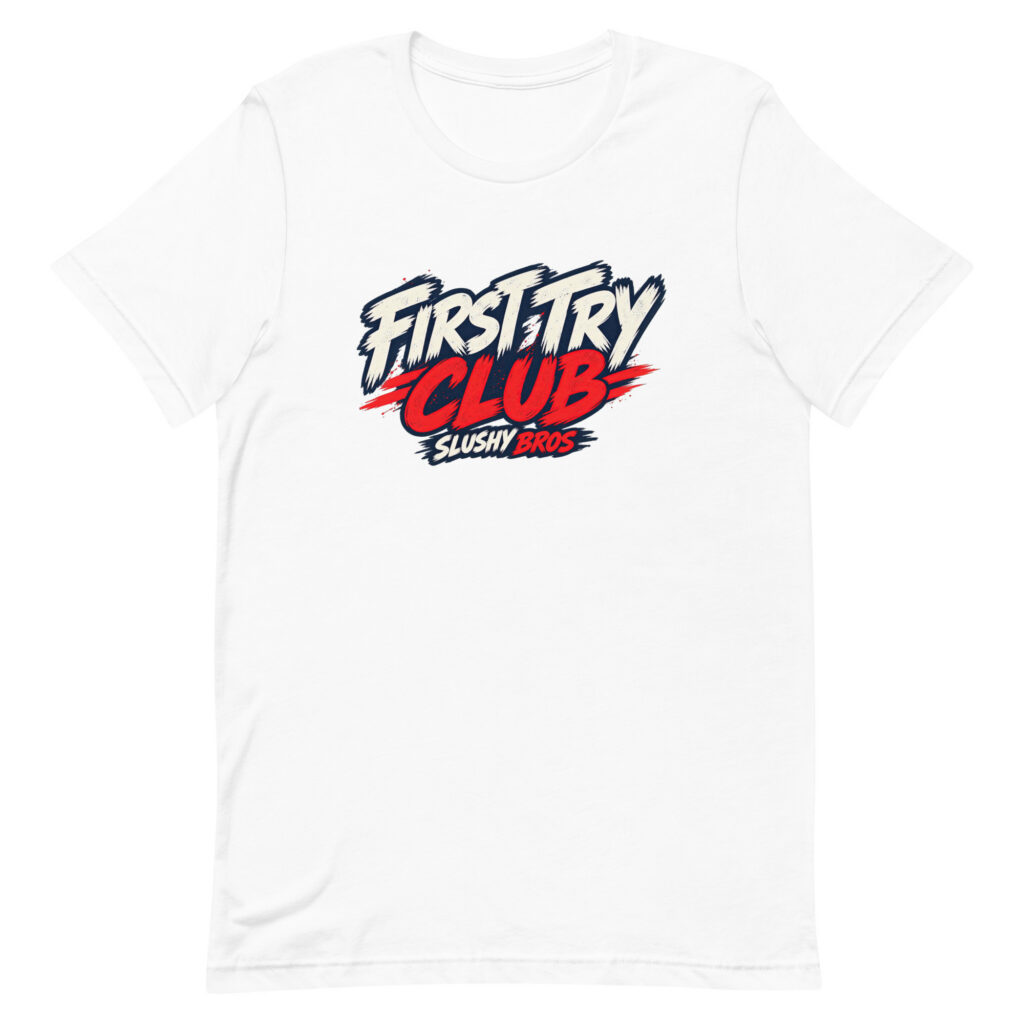
The wordmark stays the same, but colorways rotate every few months and we have run at least four so far. We keep the chest placement and sizing consistent so a replacement fits like the one you already own.
Grab the Shirt Before the Size Run Thins Out
If the line made you laugh, it will do the same thing to whoever reads it off your chest at a tailgate. The current colorways are in the Slushy Bros shop, and the middle sizes tend to disappear first.